

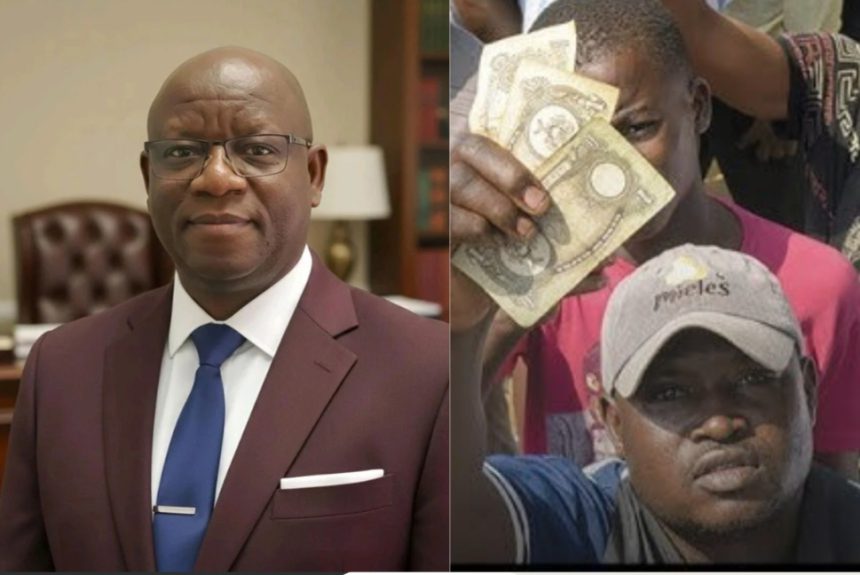

A Public affairs analyst, commentator and accountant, Dr. Bolutife Oluwadele has raised concerns over what he described as rising extremism, emotional politics and voter apathy threatening Nigeria’s democratic process.
Speaking on Inside Scoop, a current affairs programme on Adamimogo 105.1FM, Oluwadele lamented the increasing hostility among Nigerians, particularly on social media, over political affiliations.
According to him, democratic participation is gradually being replaced with intolerance and personality-driven loyalty, where disagreement is treated as enmity rather than a legitimate exercise of freedom of choice.
“When you look at social media, you see disagreements that are no longer civil,” he said. “Supporting a candidate is your right, but when people turn to cursing others who hold different views, it becomes dangerous. Democracy is about choice.”
He stressed that democracy, by definition, is a government of the people, by the people and for the people, where majority votes determine winners. However, he expressed concern that political engagement in Nigeria has become more emotional than issue-based.
“One of our biggest weaknesses is that our politics is not ideological. It is personality-driven,” Oluwadele noted. “It has become a personality cult. The person you like can do no wrong. The one you dislike can never do anything good.”
The Chartered Accountant observed that even educated and intellectually sophisticated Nigerians are not immune to such emotional partisanship, arguing that the trend does little to strengthen democratic institutions.
He compared Nigeria’s political culture with other democracies, where undecided voters often determine electoral outcomes. In those systems, he explained, political debates are structured around issues, and candidates seek to persuade rather than impose views.
“In Nigeria, we hardly even identify undecided voters. Instead, we polarise the electorate,” he said.
Oluwadele also addressed voter apathy, pointing to low turnout in recent elections, including the Abuja Municipal Area Council polls. He said declining participation reflects a mix of economic hardship, disillusionment and loss of faith in the electoral process.
While acknowledging that voter apathy is a global phenomenon, he warned that the Nigerian situation is becoming increasingly troubling.
He further decried vote buying, describing it as the “weaponisation of poverty.” According to him, politicians exploit economic hardship to influence outcomes, undermining the integrity of elections.
“The issue of vote buying has assumed a very terrible dimension in Nigeria,” he said. “It is unfortunate that poverty is being used as a political tool.”
As part of potential reforms, Oluwadele proposed a shift toward crowdfunding political campaigns to reduce the influence of godfatherism and excessive monetisation of politics. He argued that if citizens collectively fund candidates they believe in, it would promote accountability and reduce the burden of private sponsorship.
However, he admitted that implementing crowdfunding in a country grappling with widespread poverty would be challenging.
On claims of predetermined electoral outcomes, the analyst described such assumptions as damaging to democracy. He maintained that every vote counts and warned that failure to participate effectively strengthens opposing interests.
“When you don’t cast your vote, you are indirectly voting against your preferred candidate,” he said. “Those who vote are voting for someone and against someone. Those who stay away are voting against the person they claim to support.”
Oluwadele also noted that democracy is facing global pressures, not just in Nigeria. He referenced ongoing scholarly discussions around what he called the “polarity of democracy” — a framework examining how to balance justice, equality, participation and due process in sustaining democratic systems.
Despite expressing doubts about how democracy has been practised in Nigeria, he stopped short of recommending an alternative system of government, suggesting instead that the country may be undergoing a political evolution shaped by the liberalisation of information and the growing influence of social media.