

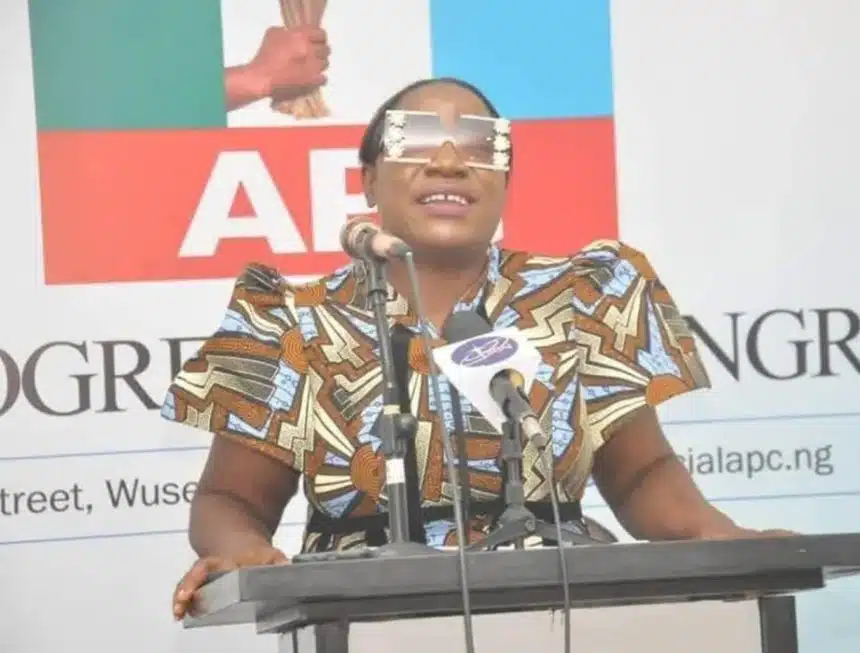

A female governorship aspirant in the October 27, 2025 shadow election of the ruling All Progressives Congress (APC) in Ekiti State, Hon. Abimbola Olajumoke Olawumi, has called for urgent reforms to boost women’s political representation in Nigeria, insisting that the proposed 25 per cent reserved legislative seats for women could mark a historic turning point for gender inclusion.
Speaking on Adamimogo 105.1FM’s current affairs programme on Monday, March 16, Olawumi argued that Nigeria’s political system has long sidelined women despite their significant role in mobilising voters during elections.
According to her, women make up nearly half of Nigeria’s population but remain grossly underrepresented in decision-making positions, particularly in the legislature.
She noted that in the National Assembly, only a handful of women occupy seats, with just four female senators and about 21 women in the House of Representatives. The situation is even more concerning at the state level, she said, revealing that at least 13 states currently have no female member in their Houses of Assembly.
Olawumi explained that the proposed reserved seats initiative is designed as a corrective measure to address decades of political exclusion rather than a policy meant to deprive men of opportunities.
“The idea is to correct the historical imbalance that has existed since Nigeria returned to democracy in 1999. Women have always done the grassroots mobilisation for political parties, yet they remain largely absent where the decisions are taken,” she said.
She argued that achieving between 20 and 25 per cent female representation in the National Assembly would significantly strengthen women’s voices in governance and create a more inclusive political environment.
Despite their strong presence during election campaigns, Olawumi lamented that women often struggle to support female candidates due to systemic barriers embedded in Nigeria’s patriarchal political culture.
She pointed to intimidation, harassment and violence as major factors discouraging women from actively contesting for political offices.
“The system we operate is deeply patriarchal. Women who dare to challenge it face intimidation and threats meant to push them out of politics,” she said.
Drawing from her personal experience as a governorship aspirant, Olawumi disclosed that female politicians frequently encounter both structural and security challenges while navigating the political terrain.
She alleged that political pressure and threats have intensified around her aspiration, revealing that an attempted abduction at her residence recently led to the kidnapping of her son.
According to her, such incidents illustrate the level of risk women face when they step into Nigeria’s highly competitive political arena.
“These are the kinds of dangers that make many women withdraw from politics despite their contributions to party campaigns and mobilisation,” she said.
While expressing optimism about the future of women in governance, Olawumi admitted that Nigeria may not yet be ready for a female president, largely due to the country’s limited record of women occupying top political offices.
She noted that Nigeria is yet to produce a female governor, stressing that the journey toward a woman becoming president must begin with stronger representation at the grassroots and state levels.
“We must start from the local government level, then move to the state assemblies and governorship positions. Once women begin to occupy these spaces in meaningful numbers, the possibility of a female president will naturally follow,” she explained.
Olawumi also highlighted structural barriers within political parties, including financial demands and entrenched power structures that often favour male candidates.
Although she acknowledged recent attempts by some parties to reduce nomination fees for women, she said deeper reforms are still needed to dismantle the culture of intimidation and exclusion.
Beyond politics, she observed that Nigerian women have made remarkable strides in business and other sectors, proving their capacity for leadership and innovation.
However, she maintained that the political system remains one of the last strongholds where gender inequality is most visible.
For Nigeria’s democracy to mature, Olawumi said cultural stereotypes that portray leadership as a male preserve must be dismantled.
She called for sustained advocacy, legislative reforms and societal change to create a political environment where women can compete fairly without fear.
“If we remove these barriers and implement policies like the reserved seats bill, Nigerian women will prove that they can perform just as well, if not better, in leadership positions,” she said.
The Ekiti politician urged women across the country to remain courageous in the face of intimidation, stressing that perseverance and policy reforms would eventually open the political space for greater female participation.