

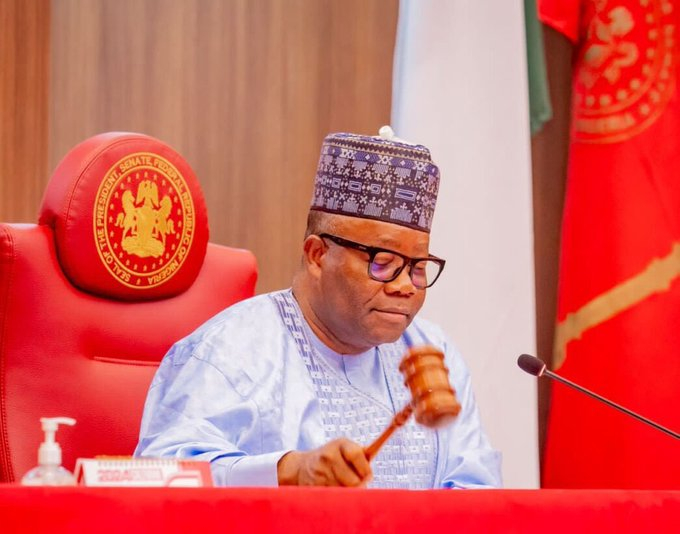

The Senate on Tuesday passed for second reading a bill seeking to repeal the Nigeria Police Trust Fund Act, 2019 and replace it with a new legal framework aimed at strengthening funding for the Nigeria Police Force.
The proposed legislation, titled the Nigeria Police Trust Fund Bill, 2026 (SB 1030), seeks to provide sustainable financing for police equipment, training, and welfare, while also restructuring how the Force is funded.
Debate on the bill was marked by heated exchanges on the floor of the Senate, particularly over the constitutionality of funding the proposed trust fund through deductions from the Federation Account.
Leading the concerns, Senator Ibrahim Dankwambo warned that the proposed 0.5 per cent deduction could be challenged in court and potentially declared “null and void,” recalling that a similar arrangement had previously been struck down following objections from state governors.
He also raised concerns about how the proposed funding structure would align with ongoing national discussions on the creation of state police, noting potential overlaps in responsibilities and financing.
Other lawmakers, including Senator Buhari Abdulfatai, argued that the core challenge facing the police was not necessarily insufficient funding, but the lack of adequate operational tools and logistics. He noted that Nigeria currently has about 300,000 police officers serving a population of over 200 million people.
The President of the Senate, Godswill Akpabio, emphasised that while there is consensus on the need to improve police funding, the key issue remains ensuring compliance with constitutional provisions.
In response, Senator Mohammed Tahir Monguno cited Section 80(2) of the Constitution to argue that the National Assembly has the authority to legislate expenditures charged to the Consolidated Revenue Fund. However, Akpabio countered that Section 81 requires such expenditures to be properly included in the annual national budget rather than implemented through direct statutory deductions.
Following deliberations, Akpabio conducted a voice vote, with the “Ayes” prevailing, allowing the bill to scale second reading.
He added that a public hearing would be held to address outstanding concerns, including accountability for previous Police Trust Fund expenditures, possible alternative funding sources, and whether the proposed framework could accommodate future discussions on state policing structures.