

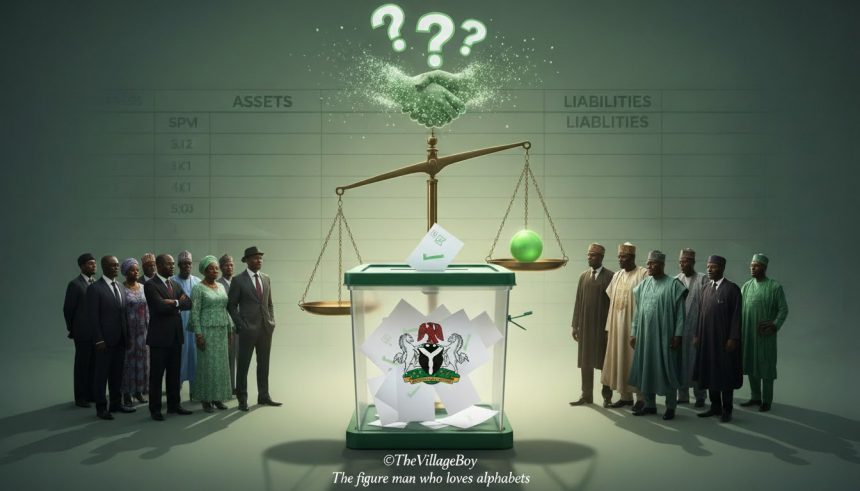

In accounting, goodwill is an intangible asset. It is the value attached to reputation, loyalty, brand strength, relationships, and future expectations beyond physical or easily measurable assets. It may strengthen a company’s valuation, especially during acquisition or disposal, but it can also be impaired if future benefits become doubtful.
Politics has its own form of goodwill. It is the trust, emotional credit, moral authority, regional loyalty, party identity, and personal reputation that candidates carry into elections. Like accounting goodwill, it can improve a politician’s valuation. It can attract supporters, soften criticism, encourage alliances, and mobilise voters. But relying on goodwill alone is risky. When performance, organisation, internal democracy, and credibility are weak, goodwill can quickly lose value.
As Nigeria approaches the 2027 elections, goodwill will be a powerful but unstable asset.
For President Bola Tinubu and the ruling All Progressives Congress, goodwill will be tested by performance. Tinubu entered office with the goodwill of long political investment: his role in building the APC, his influence in South-West politics, and his reputation as a master strategist. To his supporters, his emergence in 2023 was the reward for years of political sacrifice and alliance-building.
But by 2027, old goodwill will face new questions. Nigerians will judge the administration by the cost of food, transport, fuel, exchange rates, insecurity, job opportunities, and the overall quality of life. Economic reforms may be defended as necessary, but elections are decided by lived experience, not policy grammar. If citizens feel relief before 2027, Tinubu’s goodwill may be renewed as the credit of a leader who took difficult decisions for long-term recovery. If hardship remains severe, that goodwill may suffer impairment.
The APC also has institutional goodwill, though it is unevenly distributed. In some states, it benefits from governors, federal power, patronage, and strong structures. In others, the party is associated with economic pain and unfulfilled promises. Incumbency is an advantage, but it is not the same as goodwill. A ruling party with both incumbency and public trust is formidable. A ruling party with incumbency but declining goodwill becomes vulnerable to protest votes, elite defections, and voter apathy.
The People’s Democratic Party carries a different kind of goodwill. It still has national structures, experienced politicians, loyal voters, and the memory of its years in power from 1999 to 2015. For some Nigerians, the PDP represents a familiar alternative, especially when compared with the economic difficulties under the APC. That nostalgia is a form of goodwill.
Yet the PDP’s goodwill is weakened by internal crises. Factional struggles, zoning disputes, leadership battles, and a lack of a clear reform message have damaged its standing. If the party enters 2027 divided, its old goodwill may not be enough. Voters may want an alternative to the APC, but still doubt whether the PDP has rebuilt itself into a credible government-in-waiting.
Peter Obi presents perhaps the most interesting case of goodwill under pressure. In 2023, Obi and the Labour Party converted personal reputation into a national movement. His goodwill came from his image of prudence, modesty, discipline, and issue-based politics. The Obidient movement gave voice to young Nigerians, professionals, urban voters, and citizens tired of the old political order.
However, goodwill is not permanent. Obi’s departure from the Labour Party, his move to the ADC, and now to the NDC have added a new complication. His supporters may describe these movements as strategic repositioning. They may argue that the Labour Party’s internal problems made it necessary for him to seek a more viable national platform. In that sense, moving parties may be seen not as betrayal, but as political adaptation.
But the backlash against him is significant. The perception that Obi fears competitive primaries or prefers an automatic ticket can erode the moral capital on which his brand rests. His appeal has always depended partly on the belief that he is different from the old political class. If voters begin to see him as unwilling to submit to internal democracy, the contrast weakens.
This does not mean Obi’s goodwill will vanish. His support base remains passionate and influential. Many voters still see him as a credible alternative to the APC and PDP. Some may even believe the attacks against him are part of an establishment effort to weaken a popular outsider. But goodwill need not disappear completely before it becomes impaired. It only needs to lose value among undecided voters, coalition partners, and citizens who admired him but were not emotionally tied to him.
The danger for Obi is contradiction. If a candidate who campaigns on reform appears to want special treatment, critics will ask whether his reform message applies only to others. If a movement that claims to be citizen-driven begins to look like a personal vehicle, some supporters may grow uneasy. The best way to protect his goodwill would be to embrace transparent competition. If he submits to a credible primary and wins, his democratic credentials may be strengthened. If he appears to move from platform to platform in search of a guaranteed nomination, opponents will frame it as entitlement.
Rabiu Kwankwaso also has goodwill, especially through the Kwankwasiya movement. His strength in Kano and parts of the North-West gives him serious bargaining power. But like Obi, he must convert a strong base into a broader national appeal. If opposition politics is to challenge the APC effectively, the goodwill of Obi, Kwankwaso, the PDP, and other actors must be negotiated into a workable coalition. Otherwise, personal ambition may again divide the opposition vote.
Regional goodwill will remain crucial. Nigerian elections are shaped by ethnicity, religion, geography, elite bargains, and perceptions of inclusion. The South-West, South-East, North-West, North-East, North-Central, and South-South will all evaluate candidates differently. The North will again be decisive because of its voting strength. The South-East will watch Obi’s choices closely. The South-West will test whether Tinubu’s home advantage remains intact. No candidate can win on personal goodwill alone without building a national bridge.
Youth goodwill will also matter. Many young Nigerians are politically restless, economically pressured, and impatient with old promises. But youth support is not automatic. Young voters are not one bloc. Some are ideological, some transactional, some apathetic, and many are simply struggling to survive. Any candidate seeking youth goodwill must speak credibly to jobs, education, technology, police reform, cost of living, migration, and dignity.
Another intangible asset is institutional goodwill. Trust in INEC, the courts, security agencies, and the electoral process will affect turnout and acceptance of results. Citizens may admire a candidate, but if they believe votes will not count, enthusiasm may decline. Democracy itself needs goodwill to function.
Ultimately, goodwill will influence 2027, but it will not decide everything. Tinubu and the APC need performance. The PDP needs unity and renewal. Obi and the NDC need to show that movement politics can coexist with internal democracy. Kwankwaso must prove that regional strength can scale nationally. Young voters must move from anger to organisation. Electoral institutions must rebuild public trust.
Political goodwill, like accounting goodwill, is valuable because it points to a future possibility. But it becomes dangerous when inflated or treated as a substitute for hard assets. In politics, those hard assets are competence, structure, policy clarity, security, economic relief, credible primaries, national reach, and public trust.
By 2027, Nigerians will not merely ask who has goodwill. They will ask who has preserved it, who has wasted it, who has overvalued it, and who can convert it into national renewal. For Obi in particular, the question is sharper: can a candidate whose goodwill was built on being different survive the perception that he now wants politics to bend in his favour? That answer may determine whether his goodwill remains a premium asset or becomes impaired political capital.
©TheVillageBoy
(The figure man who loves alphabets)