

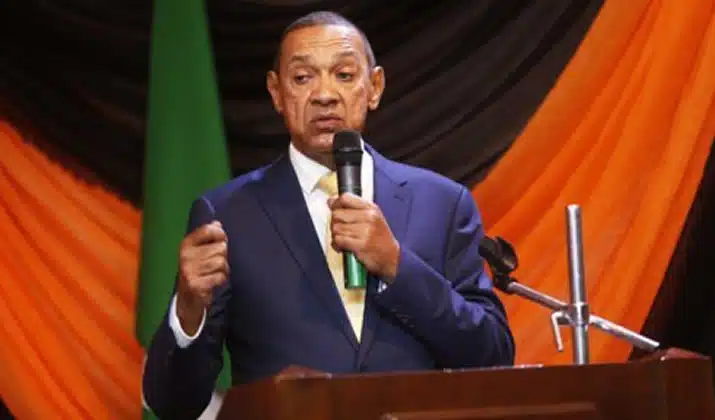

Former Senator Ben Murray-Bruce has urged President Bola Tinubu to make the rehabilitation and commercially viable operation of Nigeria’s government-owned refineries a national priority.
Murray-Bruce, in a post on X on Tuesday, said the country needed bold officials willing to confront entrenched interests, challenge bureaucratic bottlenecks and pursue measurable results even at the risk of becoming unpopular.
His comments followed President Tinubu’s renewed commitment to restoring Nigeria’s refineries to full productive capacity and ensuring that they operate profitably.
“Mr President, Nigeria needs more mad men in your government,” Murray-Bruce said, explaining that by “mad men” he meant officials who were willing to challenge a broken system and reject mediocrity.
He urged the President to place the rehabilitation of the Port Harcourt, Warri and Kaduna refineries at the centre of the country’s petroleum sector reforms.
According to him, Nigerians have heard enough explanations about turnaround maintenance, contractors, technical reviews, committees and timelines, and now want to see refined petroleum products coming from the facilities.
He also advised the Federal Government to consider alternative ownership and management arrangements if necessary to make the refineries commercially sustainable.
“If government cannot operate them efficiently, find the structure that can. Bring in world-class technical partners. Introduce private capital where necessary. Restructure them. Concession them if that produces the best outcome,” he said.
Murray-Bruce maintained that whatever model is adopted, the ultimate objective should be to make the refineries functional and profitable.
Pointing to the Dangote Refinery as evidence of Nigeria’s capacity to operate large-scale refining infrastructure, he said the government-owned facilities should collectively target at least 50 per cent of the Dangote refinery’s 650,000 barrels-per-day nameplate capacity.
That, he said, would amount to about 325,000 barrels per day of reliable and commercially viable refining throughput.
The former lawmaker also called for the appointment of a results-driven individual to spearhead the government’s ambition of increasing Nigeria’s crude oil production to four million barrels per day by 2030.
He said such an official must be prepared to confront crude oil theft, bureaucratic delays and other obstacles limiting production, while attracting investment and unlocking dormant assets in the petroleum sector.
“I don’t want another committee chairman. I want a mad man. I don’t want somebody who will spend four years explaining why something cannot be done. I want somebody crazy enough to do it,” he said.
Murray-Bruce cited Central Bank of Nigeria Governor Olayemi Cardoso and National Security Adviser Nuhu Ribadu as examples of officials who, in his view, demonstrate the results-oriented approach he believes is needed in government.
He argued that Nigeria requires more officials with a similar determination to deliver tangible outcomes.
“Two mad men are not enough for a country of more than 200 million people,” he said.