

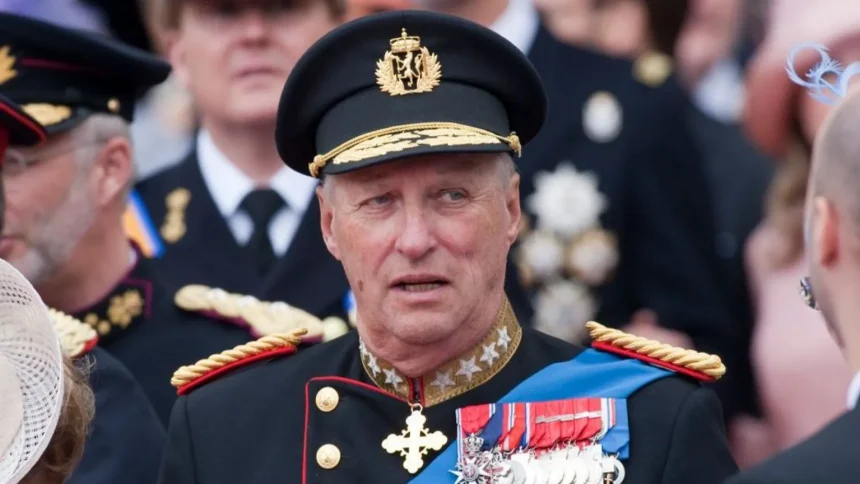

Norway’s King Harald V has died at the age of 89, bringing to an end a 35-year reign in which he became widely regarded as a modernising and deeply popular monarch.
The Royal Palace in Oslo said Harald died peacefully at 6:35am local time on Friday at the National Hospital, where he had been receiving treatment for a rare blood disorder. Following his death, the royal flag at the palace was lowered to half-mast.
Members of the royal family had gathered at his bedside in the hours before his death, while members of the public placed flowers outside the palace.
Harald’s death automatically brings his son, Crown Prince Haakon, 53, to the throne as Norway’s new king. Haakon is expected to meet the government in an extraordinary Council of State later on Friday.
Harald became king in January 1991 following the death of his father, King Olav V.
Born on February 21, 1937, at the Skaugum estate near Oslo, Harald was the first Norwegian-born king since the 14th Century.
His childhood was shaped by war. He was only three when Nazi Germany invaded Norway in 1940. His mother, Crown Princess Märtha, fled the country with her children to Sweden before the family later travelled to the United States at the invitation of President Franklin D. Roosevelt.
After the Second World War, Harald returned to Norway, completed his education and military service, and eventually studied social sciences, history and economics at Balliol College, Oxford.
He became crown prince in 1957 and succeeded his father 34 years later.
One of the defining moments of Harald’s life came before he became king. He fell in love with Sonja Haraldsen, the daughter of a businessman, but their relationship faced significant opposition because she was a commoner.
The couple waited nine years before receiving permission to marry in 1968.
Their marriage marked a significant break with royal tradition and helped pave the way for a more modern Norwegian monarchy in which royal family members could marry outside European royal circles.
Harald and Sonja were married for nearly 58 years and became one of the most familiar couples in Norway.
During his reign, Harald developed a reputation for being approachable, emotional and closely connected to ordinary Norwegians.
Royal observers frequently described him as the “People’s King”, a reflection of his informal personality and willingness to show humour and vulnerability.
Historian and royal correspondent Ole-Jørgen Schulsrud-Hansen said the monarchy became more egalitarian and transparent during Harald’s reign, including in matters involving royal finances and health.
Tove Taalesen, a royal correspondent for Nettavisen, described Harald as “one of us”, while royal expert Caroline Vagle said he had always maintained a close relationship with the Norwegian people.
Perhaps Harald’s most powerful moment as king came after the devastating terrorist attacks of July 2011.
Anders Behring Breivik killed eight people in a bomb attack in Oslo before travelling to Utøya island, where he murdered 69 people, most of them young people attending a political youth camp.
Harald responded by offering a message of unity and compassion.
In a televised address, he urged Norwegians not to allow fear to take control and encouraged people to stand together.
Weeks later, he delivered an emotional speech in which he spoke not only as king but as a husband, father and grandfather.
“I can only imagine the depth of your pain. As King of this nation, I feel for each and every one of you,” he said.
His response became one of the defining images of his reign and reinforced his reputation as a unifying figure during national crises.
Away from royal duties, Harald was an accomplished sportsman, particularly in sailing.
He represented Norway in sailing at three Olympic Games and remained involved in the sport well into his later years.
He eventually ended his competitive sailing career in 2022.
Harald was also an environmentalist and was involved in establishing the Norwegian branch of the World Wide Fund for Nature, serving as president of the organisation’s Norwegian chapter for two decades.
He was also a passionate supporter of Norwegian sports teams and frequently attended major international competitions.
Earlier this year, he welcomed Norway’s national football team to the palace after their historic run to the quarter-finals of the World Cup.