

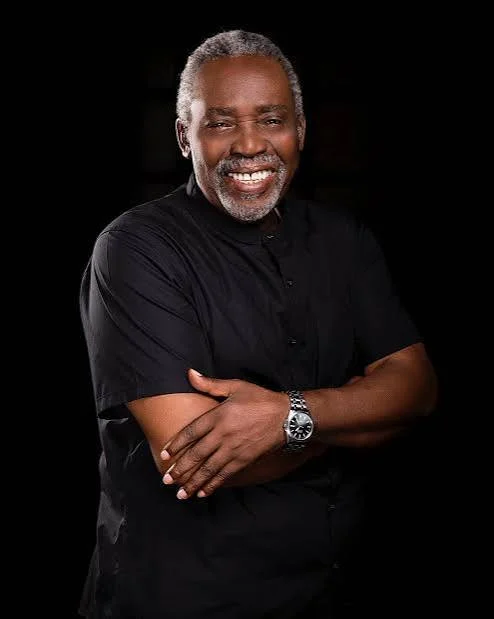

There are actors whose faces you remember. There are actors whose voices you remember.
And then there are actors whose very presence becomes part of a generation’s memory.
Olu Jacobs belonged to that rare group.
For more than five decades, Oludotun Baiyewu Jacobs moved through theatre, television and film with a presence that was difficult to ignore. He could enter a scene without saying a word and still command attention. When he eventually spoke, that deep, measured voice often made the room feel smaller.
To many Nigerians, he was the traditional ruler on the screen.
To others, he was the strict father, the powerful businessman, the respected elder, the politician, the king or the complicated patriarch.
But behind all those characters was a man whose own story was just as remarkable.
From a childhood in Kano to the stages of Britain, from international films to the emergence of Nollywood, Olu Jacobs lived a life that crossed generations, countries and eras of entertainment.
On September 16, 2026, that journey came to an end.
He was 84.
His family announced his death through his son, Olusoji Jacobs, describing him as a beloved husband, father, grandfather and uncle, and as “The Lion of Lufodo.” The family also appealed to the public to respect their privacy as they mourned.
But to understand why the death of Olu Jacobs feels like the closing of an important chapter in Nigerian entertainment, it is necessary to go back to where the story began.
THE BOY FROM KANO
Olu Jacobs was born on July 11, 1942, in Kano.
Although he was born and raised in the North, his family roots were in the Egba-Alake community of Abeokuta in present-day Ogun State.
His childhood was not initially a story about becoming one of Africa’s most respected actors.
He was simply a young boy growing up in Kano.
At Holy Trinity School, Kano, he became involved in debating and drama. Those activities gave him an early taste of performance, but acting was not yet the global career it would eventually become.
Then came an encounter that changed the direction of his life.
Jacobs watched one of the performances of Hubert Ogunde, one of Nigeria’s pioneering theatre practitioners.
Something about what he saw stayed with him.
Ogunde demonstrated that theatre could be more than entertainment. It could tell stories, preserve culture, challenge society and move people.
For the young Jacobs, the stage suddenly looked like somewhere he belonged.
That encounter strengthened his determination to pursue acting professionally.
And so began a journey that would eventually take him thousands of kilometres away from Kano.
LONDON AND THE MAKING OF AN ACTOR
Olu Jacobs did not simply wake up one morning and become a great actor.
He trained.
He studied.
He learned the discipline of the craft.
He travelled to Britain and gained admission to the Royal Academy of Dramatic Art, RADA, in London, one of the world’s respected institutions for dramatic training.
This period was important because Jacobs was learning the foundations of professional acting at a time when Nigerian theatre and film were still developing.
He went on to work with repertoire theatres in Britain and began appearing on British television.
For a Nigerian actor in that era, getting such opportunities was no small achievement.
He appeared in productions including The Goodies, Till Death Us Do Part, The Tomorrow People, The Professionals and other British television programmes.
He also moved into international cinema.
His film credits included The Dogs of War, Baby: Secret of the Lost Legend and Roman Polanski’s Pirates.
In other words, before Nollywood became a global brand, Olu Jacobs had already experienced the international stage.
But Nigeria was still calling.
COMING HOME
There is something significant about Olu Jacobs’ return to Nigeria.
He could have remained abroad and continued building his career in Britain.
Instead, he returned to a country whose entertainment industry was changing rapidly.
Nigeria’s film industry was entering a new era.
Television was growing.
Video films were becoming increasingly popular.
And the industry that would eventually be known around the world as Nollywood was beginning to find its identity.
Jacobs became part of that transformation.
He was not a newcomer trying to prove himself.
He came with years of theatre training and international experience.
And audiences noticed.
He brought something different to the screen — discipline, theatrical control, diction and an ability to make even exaggerated characters feel believable.
His career eventually stretched across hundreds of productions and more than five decades.
THE VOICE
Ask Nigerians what they remember most about Olu Jacobs and his voice will almost certainly come up.
That voice had weight.
It did not need to shout.
It could sound warm.
It could sound threatening.
It could sound disappointed.
It could sound authoritative.
And somehow, regardless of the role, it sounded like Olu Jacobs.
That voice became part of his identity.
But it was not just the voice.
It was the way he carried himself.
The way he looked at another character.
The pauses before his words.
The calmness with which he delivered a threat.
The dignity he brought to older characters.
And perhaps that is why kings and traditional rulers became some of his most memorable roles.
He had the physical presence to occupy those characters.
When Olu Jacobs played a king, audiences rarely questioned why he was the king.
When he played a father, he looked like someone who had lived long enough to know the consequences of every decision.
When he played a villain, the danger often came not from shouting but from how quietly he spoke.
That was his gift.
THE MAN WHO BECAME MANY MEN
One of the remarkable things about Olu Jacobs was the variety of characters he played.
He was not confined to one type of role.
He could be a loving father in one production and a ruthless traditional ruler in another.
He could play a wealthy businessman, a politician, a chief, a patriarch or an ordinary man struggling with family problems.
His characters were often older men with authority, but he brought enough depth to prevent them from becoming simple stereotypes.
That ability came from years of theatre.
He understood that acting was not merely about remembering lines.
It was about understanding people.
It was about knowing when to speak and when to remain silent.
It was about making the audience believe that the character existed before the camera arrived and would continue to exist after the scene ended.
That was the Olu Jacobs method audiences came to recognise.
OLU JACOBS AND JOKE SILVA
Then there was Joke Silva.
If Olu Jacobs’ professional life was remarkable, his relationship with Silva became one of the most enduring partnerships in Nigerian entertainment.
The two met in the theatre world and their professional relationship eventually became a personal one.
Their marriage brought together two accomplished actors who understood the demands of the same profession.
According to biographical accounts, they met in 1981 while working on Wole Soyinka’s Jero’s Metamorphosis at the National Theatre in Lagos. Their relationship developed over time and they eventually married.
Together, they built more than a marriage.
They built an institution.
The couple co-founded the Lufodo Group, with interests in film and the performing arts, and established the Lufodo Academy of Performing Arts to train younger people in the creative industry.
Their partnership was therefore not simply about two famous actors being married.
It was about two people building something that could survive them.
THE PRIVATE MAN BEHIND THE PUBLIC ACTOR
For decades, audiences knew Olu Jacobs as a powerful man on screen.
But away from the camera, he was a husband, father and grandfather.
His family life was largely kept away from the noise of celebrity culture.
He and Joke Silva raised their family while simultaneously managing demanding careers.
They also experienced personal pain.
Their first child, Dayo, died as a child. They later had two sons, Olusoji and Olugbenga. Olusoji eventually became involved in the family’s entertainment business.
The public saw the actor.
His family knew the husband and father.
That distinction became especially important during the final years of his life.
WHEN THE LIGHTS BEGAN TO DIM
The later chapter of Olu Jacobs’ life was very different from the decades when he dominated Nigerian screens.
He gradually withdrew from public appearances.
In 2021, Joke Silva disclosed that he had been living with dementia with Lewy bodies, a progressive condition affecting the brain.
For a man whose entire career had depended on memory, speech, movement and communication, the illness was particularly difficult.
Silva spoke publicly about the challenges, but she also tried to protect the dignity and privacy of her husband.
For years, social media repeatedly carried false reports that Olu Jacobs had died.
His family had to repeatedly correct those reports.
Even in 2024, another death rumour circulated and was dismissed.
That period offered Nigerians a glimpse of another side of celebrity — the human being behind the famous name, and the family trying to care for him while the outside world continued to speculate.
Eventually, the real announcement came.
And this time, there was no correction.
THE HONOURS
Olu Jacobs did not leave his achievements unrecognised.
In 2007, he won the Africa Movie Academy Award for Best Actor in a Leading Role.
He received the Industry Merit Award at the Africa Magic Viewers’ Choice Awards in 2013.
In 2016, he received a Lifetime Achievement Award from the Africa Movie Academy Awards.
And in 2011, the Federal Government conferred on him the national honour of Member of the Order of the Federal Republic, MFR, recognising his contribution to the arts.
But awards tell only part of the story.
Some of the most important evidence of his impact can be found in the actors who came after him.
Young performers grew up watching him.
Some eventually shared the screen with him.
Others simply studied him.
For many, Olu Jacobs represented what it meant to take acting seriously.
EIGHTY-FOUR YEARS
On July 11, 2026, Olu Jacobs turned 84.
At that point, his career had already covered more than half a century.
Think about that.
He had acted before the word “Nollywood” became globally recognised.
He had worked in British television.
He had appeared in international films.
He had watched Nigerian cinema transform from an emerging industry into a global entertainment force.
He had seen technology change the way movies were produced, distributed and consumed.
And through all those changes, his name remained familiar.
That is a rare kind of longevity.
THE FINAL ANNOUNCEMENT
Then came September 16, 2026.
The announcement came from his family.
Not from a blogger.
Not from an unverified social media account.
Not from one of the many rumours that had circulated during his later years.
His son, Olusoji Jacobs, announced that the actor had died.
The family described him as a husband, father, grandfather and uncle.
And then came the name that captured his public legacy:
The Lion of Lufodo.
He was 84.
His family asked for privacy.
And across Nigeria, people began remembering.
They remembered the voice.
They remembered the characters.
They remembered the films.
They remembered the king.
They remembered the father.
They remembered the man who could make a few words sound like an entire speech.
WHAT OLU JACOBS LEAVES BEHIND
The easiest thing to say about Olu Jacobs is that he was a Nollywood legend.
But his story is bigger than that.
He was part of a generation that helped connect Nigerian theatre with modern television and film.
He demonstrated that Nigerian actors could receive world-class training and still return home to contribute to the growth of the local industry.
He built a career across Britain and Nigeria.
He worked with different generations.
And with Joke Silva, he invested in training and developing the next generation of performers.
His legacy is therefore not only the films he appeared in.
It is also the people who learned from him.
It is the institutions he helped build.
It is the standard of professionalism associated with his name.
And it is the memories he left with millions of viewers.
THE MAN, NOT JUST THE LEGEND
Perhaps the most fitting way to remember Olu Jacobs is to remove the word “legend” for a moment.
Remember the boy.
The boy in Kano who discovered drama.
Remember the young man who watched Hubert Ogunde and decided that acting could become his life.
Remember the student who travelled to London to learn his craft.
Remember the young actor who stood on British stages and appeared on British television.
Remember the Nigerian who returned home and became one of the most recognisable faces in the country’s entertainment industry.
Remember the husband who built a life with Joke Silva.
Remember the father and grandfather.
Remember the actor who kept working for decades.
And remember the elderly man whose final years were spent away from the spotlight, surrounded by family.
Because before Olu Jacobs became a name, he was a person.
And before he became an icon, he was a young man with a dream.
THE CURTAIN FALLS
Every actor eventually leaves the stage.
For Olu Jacobs, the final curtain has now fallen.
But unlike an ordinary performance, this one does not end when the lights go out.
His performances remain.
His voice remains.
His characters remain.
The lessons remain.
The students remain.
The memories remain.
And somewhere, years from now, a young Nigerian actor may watch an old Olu Jacobs film and ask who that man was.
Someone will tell them:
That was Olu Jacobs.
The man who came from Kano.
The man who trained in London.
The man who conquered stages before Nollywood became a global name.
The man who became a king on screen without needing a crown in real life.
The man whose voice could fill a room.
The man who spent more than five decades telling stories.
The man whose life became part of Nigeria’s own entertainment story.
And perhaps that is the greatest tribute of all.
READ ALSO: Sanwo-Olu Mourns Olu Jacobs, Hails Veteran Actor’s Five-Decade Legacy
Olu Jacobs may no longer be here to perform the next role.
But the roles he played have ensured that, for generations to come, The Lion of Lufodo will never really leave the stage.