

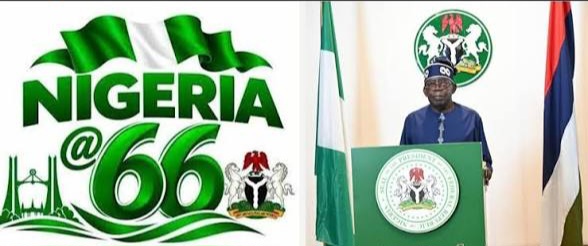

President Bola Tinubu has said Nigeria has moved beyond the most difficult phase of his administration’s economic reforms, declaring that the country will not return to fuel subsidies.
In his 66th Independence Day address on Thursday, October 1, 2026, the President defended the reforms, acknowledged the hardship they have caused and said the government’s focus would now shift from economic stabilisation to job creation, food security and reducing the cost of living.
Tinubu described Nigeria as having “passed through our own Red Sea”, saying the country had corrected its economic course and laid the foundation for future prosperity.
“Our destination is in sight. Our foundations are strong. Our direction is clear. So let us go forward. No looking back,” he said.
The President compared the reforms to chemotherapy administered to a patient battling cancer, arguing that previous governments had relied on what he called “morphine” instead of addressing the underlying problems in the economy.
He said his administration had chosen to “excise the cancer” and rejected calls for a return to fuel subsidies, describing them as unsustainable and warning against what he called the “siren song” of subsidy restoration.
Tinubu pointed to economic indicators which he said showed that the reforms were beginning to yield results.
He cited economic growth of more than four per cent, a decline in inflation from its peak, stronger foreign reserves and greater stability in the foreign exchange market.
The President also said Nigeria recorded more than $6bn in non-oil export revenue in 2025, while oil theft had declined and foreign direct investment was increasing.
He said the next phase of his administration would focus on translating those macroeconomic gains into improvements in the daily lives of Nigerians.
According to him, the priority is to reduce the cost of living by lowering the cost of producing, transporting and distributing goods.
He listed mechanised irrigation, dry-season farming, improved access to seeds and fertiliser, storage facilities and better transportation among the measures being pursued.
He also pointed to ongoing investments in roads, railways and ports to improve connections between farms, factories and markets.
Tinubu said reducing production costs would ultimately bring down prices for consumers.
“When a farmer produces more cheaply, when fewer crops are lost between the farm and the market, when a manufacturer spends less on electricity, when a truck reaches its destination faster, all those savings will ultimately find their way into the price of goods in the market,” he said.
Job creation and industrial expansion, he added, would be central to the next phase.
The President said his administration would deploy Nigeria’s gas resources to power industries, support businesses reopening factories, expand digital connectivity, develop job-relevant skills and improve access to infrastructure and finance.
He expressed a desire to see more Nigerian-made products consumed locally and exported internationally, while encouraging young Nigerians to build technology companies and create employment.
Tinubu also acknowledged that many Nigerians remain unable to afford basic necessities, including food, school fees and medical care.
He attributed the depth of the hardship to decades of low productivity, inadequate infrastructure and accumulated economic weaknesses, saying his administration could not reverse all of them within four years.
“We cannot erase in four years what accumulated over generations. But we can change its course,” he said.
The President said his administration’s ambition was not merely to manage poverty but to defeat it. He also highlighted social intervention programmes, including direct support for vulnerable households through an improved National Social Register, the Nigerian Education Loan Fund for students from low-income families and CREDICORP, which provides consumer credit for items including vehicles, solar equipment and digital devices.
Tinubu further said his administration had maintained the payment of salaries and pensions on time and in full since 2023 and had introduced reforms to the national pension system.
He ended the address with an appeal for national unity and continued support for the country’s economic transformation.
“We have travelled through difficult years together. We have made hard decisions together. And now, still together, we must build the country those decisions have made possible,” he said.
He described the Nigeria he hopes to build as a country of abundance and opportunity, where prosperity is widely shared and children can look beyond the circumstances of their birth.