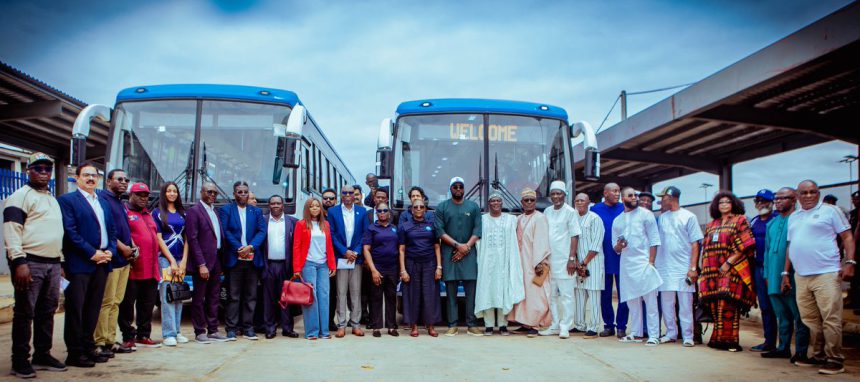

The transformation of public transportation in Lagos State has received a fresh boost with the deployment of Compressed Natural Gas buses by Amalgamated Megacity Transport Services Limited.
The investment marks a significant step in the implementation of the Lagos State Bus Industry Transition Programme, which encourages transport operators to take greater responsibility for fleet renewal and invest in modern, high-capacity and cleaner buses.
Speaking at the launch, the Lagos State Commissioner for Transportation, Oluwaseun Osiyemi, described the investment as a demonstration of private-sector confidence in the state’s vision for a cleaner, more efficient and sustainable transport system.
Osiyemi said Lagos’ transportation reform was not focused solely on buses, noting that the government was simultaneously developing rail, Bus Rapid Transit, Quality Bus Corridors, interchanges and waterways as part of an integrated multimodal transport network.
He described CNG as an important transition technology in Lagos’ clean-mobility strategy, stressing that the state’s long-term objective was to progressively move from conventional fossil-fuel-powered transportation towards low-emission and eventually zero-emission mobility.
According to him, electric buses and other emerging technologies would increasingly complement rail, buses and water transport to provide residents with more efficient transportation options while reducing emissions and dependence on conventional fuels.
The Managing Director and Chief Executive Officer of the Lagos Metropolitan Area Transport Authority, Abimbola Akinajo, said Amalgamated Megacity Transport Services had been engaged from the beginning of the transition programme with the expectation that operators would invest in acquiring and renewing their fleets.
Akinajo disclosed that the company had committed to acquiring 50 CNG buses, with 15 already delivered and the remaining 35 expected before the end of 2026.
She said the investment showed that the transition towards cleaner transportation was moving beyond government policy to become an active part of the state’s transport industry.
“This is the direction we expect the industry to go,” Akinajo said, stressing the need for operators to take greater ownership of fleet renewal and investment.
She added that Lagos currently requires approximately 15,000 high-capacity buses to meet its growing transportation needs, alongside rail and water transport services being developed under the state’s multimodal transport strategy.
According to her, the rising population, expanding economic activities and increasing demand for mobility make private-sector participation critical to closing the infrastructure and fleet gap.
Akinajo said LAMATA would continue to create an enabling environment for transport operators to invest, innovate and improve services, while acknowledging that the scale of investment required to meet Lagos’ transportation needs could not be achieved by government alone.
The deployment of the CNG buses therefore represents not only an expansion of Lagos’ public transport fleet but also a shift towards greater private-sector participation in the modernisation and decarbonisation of the state’s transport system.