

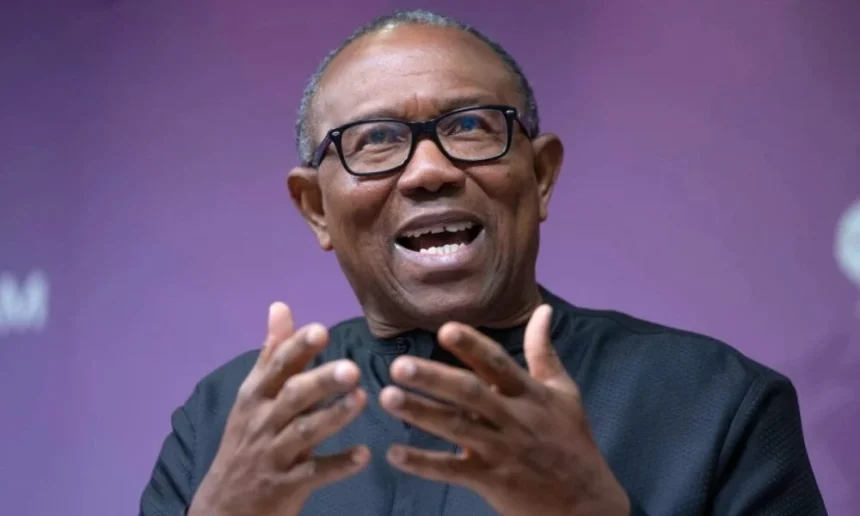

The presidential candidate of the Nigeria Democratic Congress (NDC), Peter Obi, has criticised President Bola Tinubu’s economic policies, arguing that improvements in some macroeconomic indicators have yet to translate into better living conditions for Nigerians.
Obi, in a statement, said the Federal Government should not interpret a recent World Bank report on Nigeria’s economic performance as proof that citizens’ living standards had improved, citing persistent poverty, unemployment and inequality.
The former Anambra State governor maintained that economic progress should be measured by reductions in poverty, job creation and improved access to essential services, including food, healthcare and education.
He argued that increased government revenue, stronger foreign reserves and gross domestic product growth did not necessarily indicate economic stability if citizens continued to struggle to meet basic needs.
Obi also raised concerns over the country’s debt burden, citing figures he attributed to the World Bank report titled “Beyond the Federal Purse: How Higher Revenues Reshaped State Priorities.”
According to him, the Federal Government spent N7.7 trillion on debt interest payments between January and June 2026, against total revenue of N6.2 trillion during the same period. He said the figures indicated that interest payments exceeded revenue by about N1.5 trillion.
The NDC candidate further alleged that capital expenditure declined by approximately N700 billion in the first half of 2026, questioning the government’s fiscal priorities despite increased revenue generation.
He accused the Tinubu administration of excessive borrowing, corruption and poor economic management, while faulting what he described as its selective presentation of economic statistics.
Obi also cited a United Nations Development Programme report, which he said identified Nigeria among countries where progress in poverty reduction had been reversed. He argued that the government’s economic policies had not adequately protected vulnerable citizens.
The former Labour Party presidential candidate urged the administration to review its reforms and ensure that their benefits were visible, measurable and broadly shared, rather than focusing primarily on macroeconomic indicators.
He maintained that the ultimate measure of economic success should be whether Nigerians could afford food, access healthcare, improve their living conditions and escape poverty.