

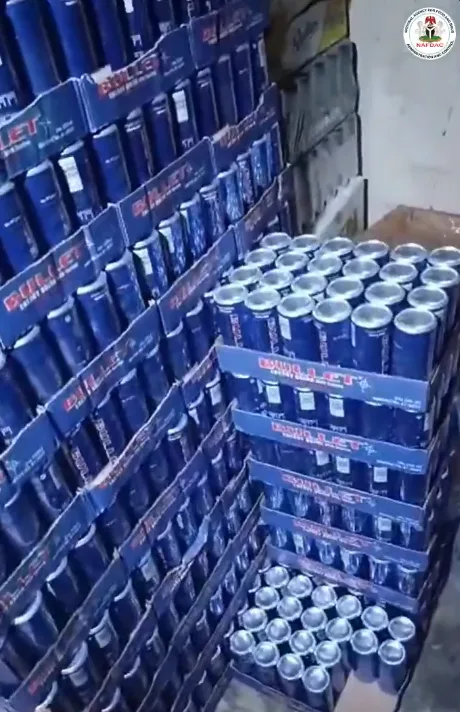

The National Agency for Food and Drug Administration and Control has arrested two persons during a raid on a suspected counterfeit drinks production facility at the Trade Fair Complex in Ojo, Lagos State.
The suspects, identified as Chibuzor Okafor and William John, were apprehended at a two-storey building in Zamfara Plaza, BBA Trade Fair Complex, along the Badagry Expressway.
NAFDAC officials reportedly recovered equipment and materials suspected to have been used to produce and repackage counterfeit alcoholic beverages and energy drinks.
The agency said the operation followed intelligence gathering and surveillance targeting suspected counterfeit product manufacturers operating within the Trade Fair International Market.
Speaking during the raid, the Assistant Director of NAFDAC’s Investigation and Enforcement Directorate, Kunle Ojo, said officers arrived at the facility and found some of the suspects allegedly engaged in the production of alcoholic drinks.
He expressed concern over the discovery, saying the operation was part of the agency’s efforts to prevent potentially dangerous products from reaching consumers.
“What we have discovered today is a lot, and it’s mind-boggling. We are here to protect the lives of many Nigerians,” Ojo said.
Items recovered during the operation included drums, filters, packaging materials, a heating device and other equipment suspected to have been used in the alleged production process.
Ojo disclosed that NAFDAC had intensified its enforcement operations ahead of the festive season, when demand for alcoholic beverages and other drinks typically increases.
He warned that counterfeit drinks could endanger consumers because their ingredients, production conditions and compliance with required quality standards might not be verified.
The agency official also condemned the suspected practice of producing substandard beverages for financial gain, urging those involved to abandon the illegal trade.
“You are killing Nigerians to make money, which is not good,” he said.
NAFDAC’s operation forms part of its efforts to curb the circulation of counterfeit and potentially unsafe products in Nigerian markets, particularly as consumer demand rises during festive periods.