

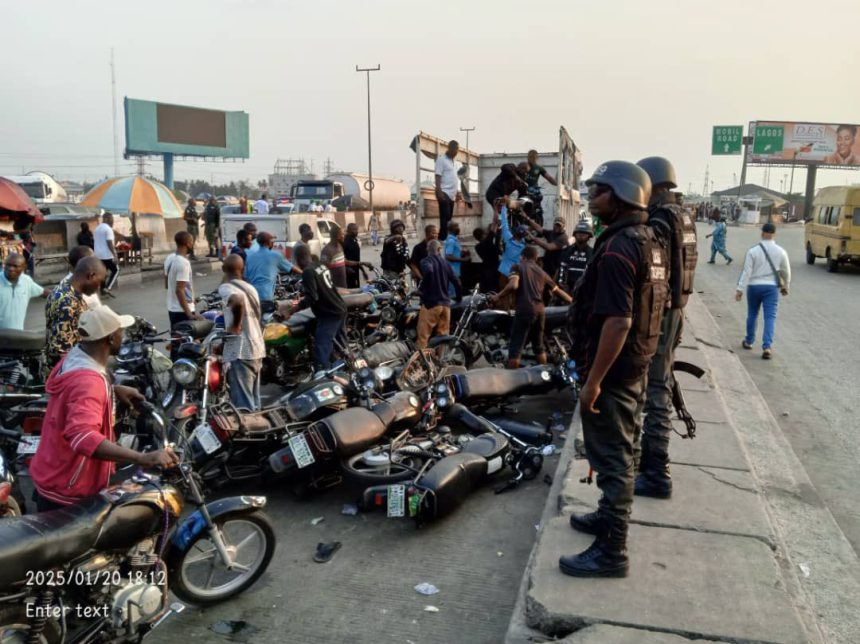

 Despite a longstanding ban on commercial motorcycles across major highways and key parts of Lagos State, okada operations continue openly, raising concerns about enforcement, safety, and transportation alternatives.
 Despite a longstanding ban on commercial motorcycles across major highways and key parts of Lagos State, okada operations continue openly, raising concerns about enforcement, safety, and transportation alternatives.
The Lagos State Government maintains a strict prohibition on commercial motorcycles across major highways, bridges, and in ten Local Government Areas as well as fifteen Local Council Development Areas. The policy, designed to enhance public safety and improve security, affects locations including Eti-Osa, Ikeja, Lagos Island, and Surulere.
Under the law, both riders and passengers risk severe penalties, including fines and prison sentences of up to three years for violations. Yet, years after the ban was introduced, compliance remains a challenge.
Defiance Along Restricted Corridors
Observations by Adamimogo 93.1 FM along coastal corridors and adjoining major roads reveal widespread disregard for the restriction. Commercial motorcyclists were seen operating in broad daylight in areas where their activities are clearly prohibited.
Many riders acknowledge that their operations are illegal but argue that commercial motorcycling remains their only viable source of income. Others appear undeterred by enforcement efforts, expressing confidence that arrest is unlikely due to perceived protection or weak monitoring.
Inconsistent Enforcement
Findings indicate that enforcement actions such as arrests, confiscation of motorcycles, and payment of fines still occur. However, these measures appear inconsistent, allowing illegal operations to persist and limiting the overall effectiveness of the ban.
Residents Caught in the Middle
For many residents, the decision to patronize commercial motorcycles is driven by necessity rather than choice. Persistent traffic congestion and unreliable public transportation options have made it difficult for commuters to meet work schedules and appointments without relying on okada.
Although some residents recognize the safety risks associated with motorcycle transportation, they argue that the absence of faster and more dependable alternatives leaves them with limited options.
Renewed Government Crackdown
In response, the Lagos State Government has intensified enforcement efforts against banned commercial motorcycle operations, one-way driving, and illegal structures along the Lagos–Calabar coastal highway corridor.
According to the Commissioner for Environment and Water Resources, Tokunbo Wahab, more than fifty motorcycles have recently been confiscated for violating traffic laws, while ten vehicles were apprehended and charged to court for driving against traffic.
Questions That Remain
As state authorities continue to uphold the ban, critical questions persist about the consistency of enforcement and the availability of sustainable transportation alternatives. Without addressing these gaps, the struggle between regulation, livelihood, and mobility in Lagos may remain unresolved.
Check out related story: Importance of Street Trading In Lagos