

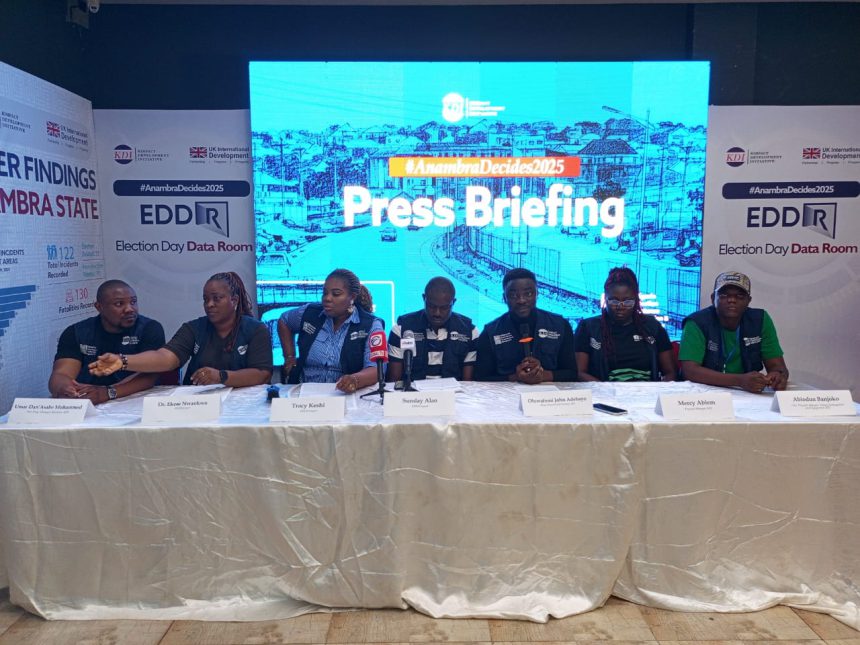

The Kimpact Development Initiative (KDI) has expressed concern over logistical lapses, security shortfalls, and incidents of vote trading in the ongoing Anambra State governorship election.
The organisation made the observations during its mid–election day briefing held at BON Hotels, Awka, under the Nigeria Election Violence Education and Resolution (NEVR) Project.
Addressing journalists, Bukola Idowu, KDI’s Team Lead, said the organisation deployed over 370 trained observers across the 21 local government areas of the state to provide real-time updates and independent assessment of the election’s conduct.
According to preliminary findings from KDI’s Election Day Data Room (EDDR), officials of the Independent National Electoral Commission (INEC) and voting materials arrived late at about 32% of polling units, delaying the commencement of voting beyond 8:45 a.m. in nearly half of the locations observed. In some cases, INEC ad-hoc officials attributed the delays to the absence of security personnel to escort them from Registration Area Centres (RACs) to polling units.
Despite the late start, the BVAS devices reportedly functioned effectively in 95.6% of polling units, with minor disruptions linked to poor network connectivity. However, 1.76% of the devices broke down, forcing electoral officers to resort to facial authentication where fingerprints failed to register.
KDI also reported widespread compromise of ballot secrecy, noting that some voters displayed their marked ballots to party agents in exchange for cash rewards. “In several locations, voters were led away by party agents after confirming their votes to collect payments,” the group said, warning that the practice undermines the credibility of the election.
The organisation identified vote-buying and interference by party agents from major political parties, notably the All Progressives Grand Alliance (APGA), All Progressives Congress (APC), and Young Progressives Party (YPP), as recurring issues. Observers documented that party representatives offered cash inducements ranging from ₦3,000 to ₦10,000, and set up so-called “verification points” where voters received money after voting.
“These violations represent a fundamental assault on the integrity of the electoral process,” the group said, criticising the failure of INEC officials and security personnel to curb the illegal activity.
While the Nigeria Police and the Inter-Agency Consultative Committee on Election Security (ICCESS) had announced the deployment of 55,000 security personnel, KDI said its field reports revealed a troubling disconnect between the official figures and actual presence on the ground. Observers reported that security personnel were sparse in urban and semi-urban centres, though concentrated in parts of Anambra South, particularly Aguata. In Awka South LGA, Ward 19, Polling Unit 21, no security official was seen as at 9:57 a.m.
KDI also documented 21 incidents of violence across more than 1,000 polling units observed. These included group clashes, intimidation, physical assault, and ballot box snatching, with hotspots recorded in Oyi, Ogbaru, Njikoka, Anambra East, Anaocha, Nnewi North, Orumba, and Nnewi South LGAs. One incident reportedly involved a security officer who discharged tear gas at a polling location.
Preliminary turnout figures indicated low voter participation in many polling units, with some officials seen sitting idle due to sparse attendance. KDI, however, expressed optimism that more voters might still show up before the close of polls.
Calling for calm and vigilance, Idowu urged voters to remain peaceful and report any irregularities through credible channels such as INEC’s helpline or KDI’s toll-free line (08000010000).
“We reiterate the importance of transparency at every stage of the election and emphasize that the final results must truly reflect the will of the people,” he said.
KDI reaffirmed its commitment to promoting democratic integrity and non-violence through its NEVR Project, supported by the UK Foreign, Commonwealth and Development Office (FCDO). The project establishes an Election Security Early Warning System (ESEWS) to track potential threats before, during, and after elections, using data-driven advocacy and partnerships with civil society, security agencies, and political stakeholders.
As voting continues across the state, KDI urged the Independent National Electoral Commission (INEC) and security agencies to address the reported lapses swiftly to ensure the process remains peaceful, credible, and reflective of the people’s mandate.