
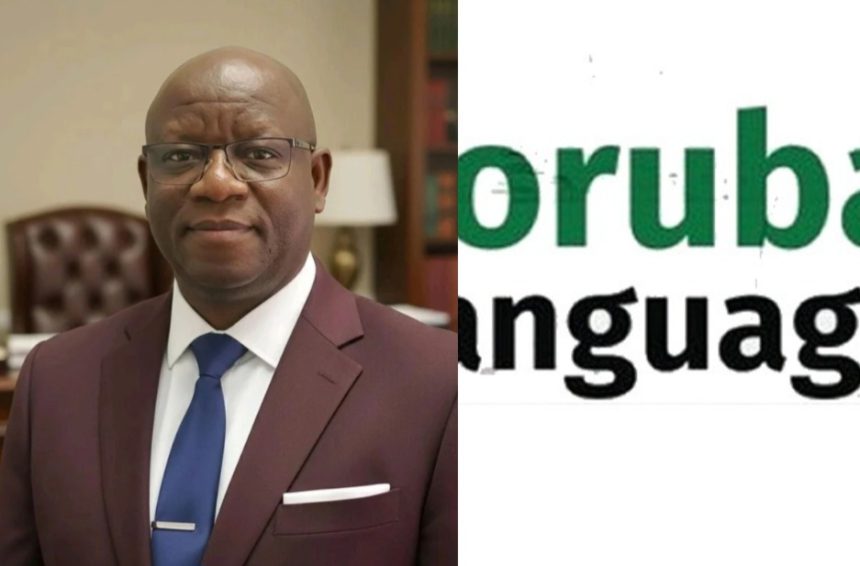

Nigeria must reform its language policy to avoid the growing neglect of indigenous languages, particularly Yoruba.
A public affairs analysts and social commentator, Dr. Bolutife Oluwadele says this continuous neglect is posing a serious threat to cultural identity and intellectual development.
Speaking during an interview on Inside Scoop on Adamimogo 105.1FM, Oluwadele reflected on the linguistic struggles many Nigerians faced growing up and how those experiences have shaped parenting decisions that now inadvertently endanger native languages.
“I would first think in my Ekiti dialect, translate it to General Yoruba, then translate it to English just to write a 10-line composition,” he recalled. “You can imagine the torture just to write in English, which is considered the language of business in Nigeria.”
He explained that many parents who endured that experience decided to raise their children primarily in English to spare them similar difficulties. However, he noted that this well-intentioned decision has led to unintended consequences, a gradual erosion of indigenous identity.
“We lost that chance,” he said, referring to children’s early capacity to learn multiple languages. “A child can learn as many languages as possible while growing up. But when we limit them to English, we take something away from them.”
Drawing comparisons with Asian communities abroad, Oluwadele observed that Chinese, Japanese and Russian parents consistently speak their native languages to their children, switching to English only when necessary. According to him, this deliberate bilingual or multilingual upbringing allows children to thrive in both local and global contexts.
He cited personal experiences from Kaduna, where children raised in multi-ethnic compounds naturally became fluent in several Nigerian languages through daily interaction.
In one compound, he said, children of Igbo origin who had never visited the South-West spoke fluent Yoruba simply because they grew up among Yoruba-speaking families. Similarly, in his own family residence in Kaduna State, children interacted daily with peers from Yoruba, Igbo and other ethnic backgrounds, acquiring multiple languages effortlessly.
“You are looking at children speaking four or more languages fluently, including English,” he said. “That is the power of interaction.”
For Oluwadele, language goes beyond communication, it shapes thought patterns, behaviour and identity.
“When a child loses his language, he loses part of his identity. He begins to think like someone else and act like someone else. It is very sad,” he said.
He acknowledged that some older children are now attempting to relearn Yoruba after experiencing embarrassment among peers who speak it fluently. He also noted the emergence of grassroots solutions, including Yoruba community associations abroad organising language tutorials for children.
In his current city, he said, a Yoruba association has established weekend classes to teach children the language. Parents also supplement home teaching with digital resources such as YouTube tutorials, blending technology with cultural preservation.
Despite these private efforts, Oluwadele insisted that lasting change must come through institutional reform.
“It will require a change of curriculum,” he said, describing Nigeria’s education framework as largely colonial in orientation even decades after independence.
He argued that integrating indigenous languages into early education including subjects such as mathematics and science would enhance comprehension and cognitive development. He referenced countries like China, which have successfully prioritised Mandarin as a language of instruction while remaining globally competitive.
Encouragingly, he pointed to emerging creative efforts, including science fiction materials produced in Yoruba with full animation, as signs that local languages can adapt to the digital age.
“With the visual era we are in now, individuals are already doing something. Over time, these efforts can be harmonised into a structured body of study in Yoruba,” he said.
However, he admitted that reversing decades of linguistic neglect would require patience and persistence.
“It is going to be a marathon,” Oluwadele concluded. “We are trying to correct what has been wrong for a long time.”