

Former President Olusegun Obasanjo and former Ekiti State governor, Ayodele Fayose, on Monday reignited their decades-old feud, with Fayose verbally attacking the 89-year-old statesman and declaring that he “belongs in the zoo.”
The renewed hostility marks yet another chapter in a turbulent relationship that has spanned over two decades, beginning in the early years of Nigeria’s Fourth Republic when Obasanjo served as president and Fayose governed Ekiti State.
Their conflict intensified after Obasanjo ordered the Economic and Financial Crimes Commission (EFCC) to investigate Fayose over an Ekiti poultry project the administration alleged was riddled with corruption. Since then, both men have maintained a frosty, often confrontational relationship.
Fayose has repeatedly accused the former president of hypocrisy, alleging that the Olusegun Obasanjo Presidential Library in Abeokuta was funded through questionable means. He has publicly demanded the refund of his N10 million contribution to the project, insisting the library symbolizes the corruption Obasanjo claims to fight.
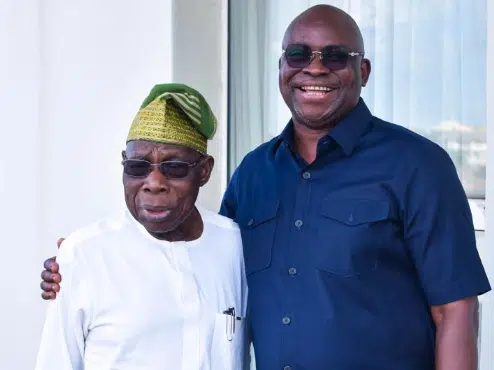
Despite their deep-seated animosity, the political landscape took an unexpected turn last week when Fayose paid Obasanjo a surprise visit at his residence in Ogun State ahead of his 65th birthday. He also extended a formal invitation to the former president to attend the celebration.
Obasanjo honoured the invitation and appeared as the Special Guest of Honour at the birthday party held in Lagos. But in a moment that stirred renewed controversy, the former president used his goodwill message to reflect on Fayose’s long history of verbal attacks.
Obasanjo recounted how Fayose “abused him countless times” without provocation, stirring murmurs among guests and setting the stage for a fresh round of hostilities. Fayose fired back shortly after, issuing new insults that triggered a public revival of their long-standing grudge.
With the latest outburst, the decades-long animosity between both men appears far from over, underscoring one of the most enduring personal and political rivalries in Nigeria’s democratic era.