

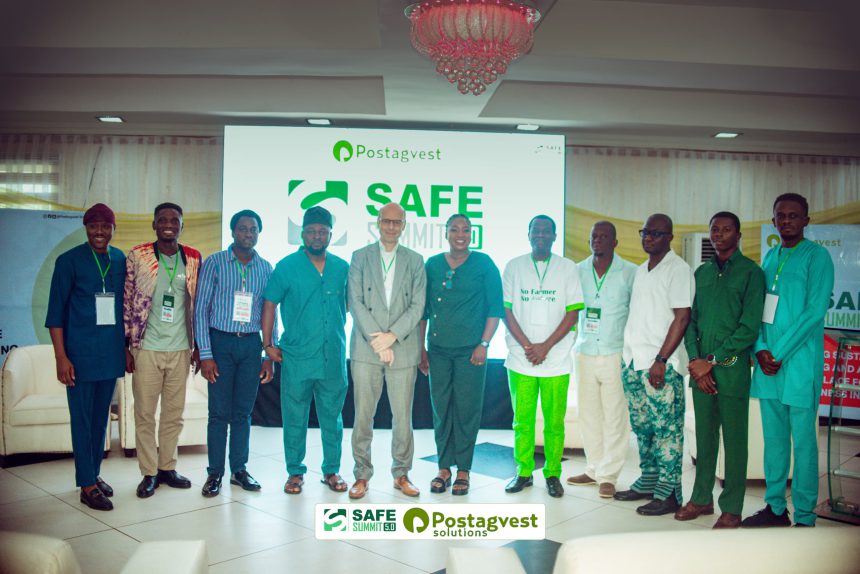

The Speak Agriculture for the Future Economy (SAFE) Summit, organised by Postagvest Solutions Limited, has reaffirmed its commitment to reshaping Nigeria’s agricultural landscape through strategic collaboration, innovative financing, and sustainable market development.
Over the years, the SAFE platform has evolved into a powerful multi-stakeholder ecosystem, bridging farmers, investors, policymakers, and agritech innovators to drive productivity, inclusiveness, and sustainability across agricultural value chains. This year’s edition, themed “Achieving Sustainable Financing and a Thriving Marketplace for Agribusiness in Nigeria,” underscored the dual pillars necessary for agribusiness success: finance and markets.
According to a communiqué signed by Mayowa Ekundayo, Co-founder and Chief Operating Officer of Postagvest Solutions Limited, and Convener of SAFE Summit 5.0, Nigeria’s agricultural sector, contributing over 25% of the nation’s GDP and employing the majority of its rural population, faces structural challenges. These include limited access to credit, production risks, poor infrastructure, and weak market linkages.
Ekundayo noted that such hurdles now affect not just smallholder farmers, who produce about 80% of the nation’s food, but also other agribusiness actors along the value chain.
“This year’s summit was designed to explore innovative solutions to Nigeria’s weak agribusiness financing structures and fragmented markets,” Ekundayo said. “Our goal is to enable productivity, profitability, and long-term sustainability within agricultural systems.”
The event attracted high-profile participants, including His Excellency Michel Deelen, Consul General of the Kingdom of the Netherlands; the Ekiti State Commissioner for Agriculture; and representatives from Horti Nigeria, Ecotutu, East-West Seeds, Pricepally, Eupepsia Place (Soiless Farm Lab), Cato Foods, Integrated Aerial Precision, Jollof Mash, IAMN, and Green Development & Agro Allied Service.
Awards were also presented to outstanding graduates and top-performing groups from the Raise a Farmer Initiative (RAFI) 4.0, a Postagvest-led youth empowerment programme that equips young Nigerians with agribusiness skills.
Key Outcomes and Recommendations
The summit’s communique outlined several actionable recommendations to transform Nigeria’s agribusiness ecosystem:
- Commendation for Ekiti State Government: SAFE applauded Ekiti State’s ongoing agricultural initiatives aimed at strengthening food security and fostering economic empowerment, noting the state’s strong comparative advantages in key value chains.
- Dutch Investment Interest: The Kingdom of the Netherlands expressed readiness to explore investment opportunities in Ekiti State’s agricultural sector, signaling growing international confidence in local agribusiness potentials.
- Organised Funding Access: The summit called for structured organisations—such as cooperatives and cluster groups—through which smallholder farmers can access financing more efficiently. This approach enhances coordination, traceability, and sustainability across production networks.
- Infrastructure and Data Development: Participants urged government agencies to create enabling environments with critical infrastructure—such as cold chains, mechanisation support, and processing facilities—guided by structured data on farmers, agribusinesses, and measurable impact indicators.
- Financial Synergy: A stronger relationship between financial institutions and agribusinesses was recommended, including training bank agriculture desks on field realities. This would promote affordable, long-term financing, insurance-backed de-risking, and capital alignment for the sector.
- Age Limit Expansion: Delegates proposed widening the current 18–35 youth agribusiness age bracket to accommodate more experienced agripreneurs who can better utilise available funding opportunities.
- Capacity Development: The summit emphasized comprehensive training for agribusiness actors—not only in technical operations but also in financial literacy, compliance, record-keeping, and market engagement.
- Blended Finance and Insurance: Participants encouraged the adoption of blended financing models supported by mandatory insurance policies to strengthen agribusiness resilience.
- Demonstration Fields: The summit underscored the importance of building demonstration farms to improve extension services and ensure knowledge transfer between older farmers and the next generation.
- Export Market Compliance: Agribusinesses eyeing export opportunities were advised to study and meet the regulatory standards of their target markets through collaborative, bottom-up approaches.
- Collaborative Framework: Finally, SAFE Summit 5.0 recommended a unified action plan among governments, financiers, and private-sector players to institutionalise sustainable financing and build a vibrant marketplace for Nigerian agribusiness.
The SAFE Summit 5.0 reaffirmed that Nigeria’s agricultural transformation lies in structured collaboration, data-driven policy, inclusive financing, and youth engagement.