

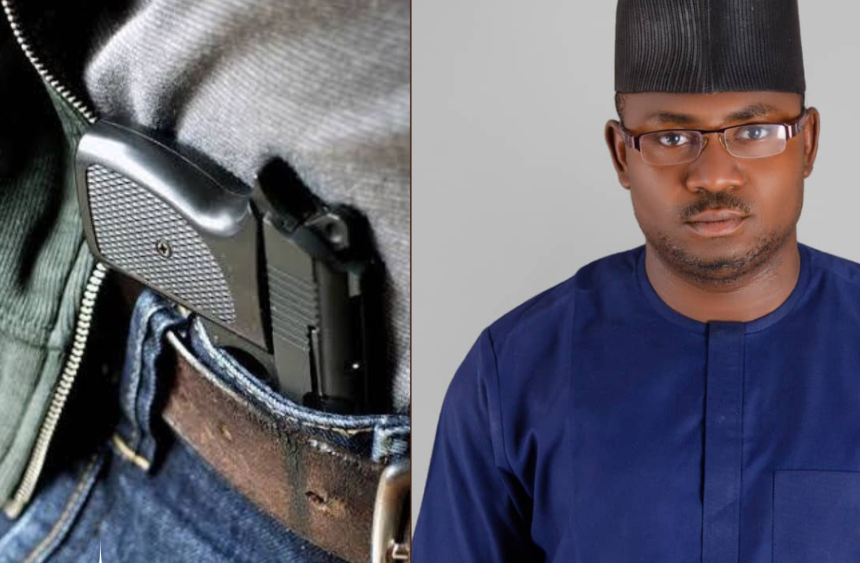

A retired military officer and security analyst, Siyaka Nasiru, has cautioned against calls for widespread civilian gun ownership, describing the idea as “a dangerous emotional reaction” to Nigeria’s worsening insecurity. Nasiru gave the warning during a live interview on Adamimogo 105.1 FM, Ibadan, where he analysed the growing debate over whether Nigerians should carry arms for self-defence.
The conversation comes on the heels of renewed public anger following repeated kidnappings and violent attacks across the country. In the last two weeks alone, more than 490 people have been abducted by bandits in multiple states. Communities like Eruku in Ekiti Local Government Area of Kwara State have suffered repeated abductions within days, fuelling widespread frustration over the government’s “stay calm, we are on top of the situation” assurances.
Asked what options citizens have when “pressed to the wall,” Nasiru said the problem reflects “a weak security apparatus” in some regions, but insisted that taking up arms is not the solution.
“For you to hold any arms, whether small or big, to defend yourself, you are doing so at your own detriment and against the law,” he said. “Self-defence starts with intelligence sharing. Reporting suspicious movements to the authorities is also defending yourself.”
His comments directly counter a recent statement by Senator Francis Fadahunsi, who argued that “responsible Nigerians” should be allowed to bear arms. But Nasiru described the senator’s position as impulsive and dangerous.
“He has certain protections many citizens do not have,” Nasiru said. “Arms are capital-intensive. If a few people can afford them and many cannot, how do you ensure balance? And when the storm is over, how do you control the weapons? It is the beginning of the terrorism we are seeing today.”
He recalled how armed groups in Borno State, initially empowered for political reasons, later morphed into insurgents.
The analyst also questioned which successful global model Nigeria intends to copy.
“If you are calling 250 million Nigerians to own arms, how do you control them? Which country has done that successfully?” he asked. “Even in the U.S., where gun ownership is legal, people are still misusing that privilege. Only yesterday, a family of four was killed.”
Nasiru said Nigeria must first stabilise its security before considering large-scale civilian access to firearms.
While acknowledging that some Nigerians already legally bear arms under strict licensing conditions, he warned that expanding such access could overwhelm law enforcement and worsen violence.
Instead, he urged the federal and state governments to strengthen intelligence-driven operations, involve traditional institutions, and rebuild trust within communities.
“The most sound intelligence comes from locals,” he said. “But many people fear retaliation from terrorists if they report them. Traditional rulers know the boys causing trouble in their communities. This is where we need to start, not by giving everyone guns.”
On whether Nigeria should copy the 120 countries with regulated firearm ownership, Nasiru insisted that any move must align strictly with existing laws.
“If Nigeria wants it, let it start from the National Assembly,” he said. “The law must change first. Until then, it is illegal.”
The conversation also touched on claims by former President Olusegun Obasanjo that Nigeria possesses enough surveillance equipment, including drones, to track and neutralise criminals. But Nasiru disagreed.
“The drones we have are not enough, and we may lack the technical know-how to use them effectively,” he said. “Government must invest more in modern equipment and recruit more personnel across the military, police, civil defence and the DSS.”
He expressed strong support for foreign intervention, whether through training, intelligence support or technical assistance to help Nigeria confront terrorism.
“If we can seek foreign support for economic problems, we can also seek it for security challenges,” he said. “As long as it remains under the control of our government, there is nothing wrong with it.”
According to him, the path to safety lies in stronger institutions, community cooperation, and modern policing, not firearms in every home.