

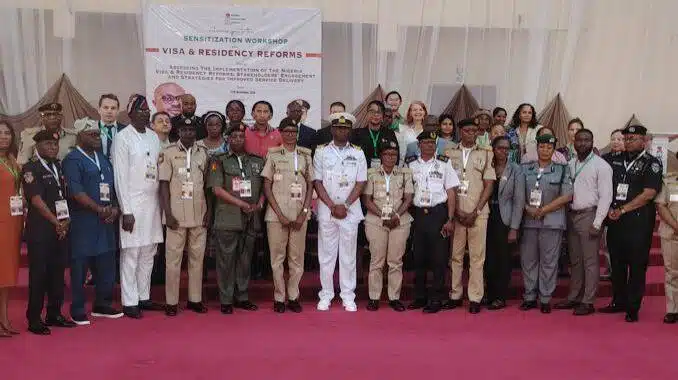

The Nigeria Immigration Service has called for increased cooperation among security and regulatory agencies to ensure the effective implementation of the country’s visa and residency reforms.
The Comptroller-General of Immigration, Kemi Nandap, made the appeal on Tuesday during a stakeholders’ sensitisation workshop held at the service’s headquarters in Abuja.
The workshop, which focused on assessing the implementation of the Nigeria Visa and Residency Reforms, brought together representatives of the Nigeria Customs Service, Nigeria Police Force, Nigerian Navy, Nigeria Security and Civil Defence Corps, Federal Fire Service and members of the diplomatic corps.
Nandap said the reforms were designed to eliminate delays associated with manual processes, improve transparency, enhance service delivery and strengthen national security.

She explained that the initiative introduced technology-driven platforms, including the electronic visa system, which became operational on May 1, 2025, allowing eligible foreign nationals to apply for Nigerian visas online and receive decisions within 48 hours.
The reforms also introduced new visa categories, including F9A and F9B for adult and minor Nigerians returning with foreign passports.
The Immigration chief further highlighted the Electronic Temporary Work Permit, launched on August 1, 2025, to simplify applications by companies seeking foreign technical experts.
She said the platform replaced the previous manual process with digital applications, biometric capture and insurance requirements.
Also introduced was the electronic Comprehensive Expatriate Residence Permit and Automated Card, which modernised residence permit applications and renewals, alongside a new Investors Residence Permit aimed at attracting foreign direct investment.
Despite the improvements, Nandap acknowledged that users still experienced challenges, particularly with payment processes and technical issues on the online portal.
She said the workshop was organised to obtain feedback from stakeholders and identify practical solutions to the challenges.
The Comptroller-General stressed that the success of the reforms required collective efforts, improved intelligence sharing and sustained cooperation among relevant agencies.
READ ALSO:EFCC Clears Immigration CG Kemi Nandap, Says Visa Fraud Probe Targets Officers
“The success of these reforms is not the responsibility of the Nigeria Immigration Service alone. We need the support and cooperation of all stakeholders,” she said.
Meanwhile, the Comptroller-General of Customs, Bashir Adeniyi, represented by the Assistant Comptroller-General for Tariff and Trade, F.T. Nmadu, described the reforms as a national border-management responsibility that required coordinated institutional action.
Adeniyi maintained that no single agency could independently address the complexities of modern border management, stressing the importance of collaboration, expertise sharing and practical solutions to common challenges.
He said, “No single agency can effectively address the complexity of modern border management on its own. Our success depends largely on our ability to work together, share expertise, and develop practical solutions to common challenges.”