

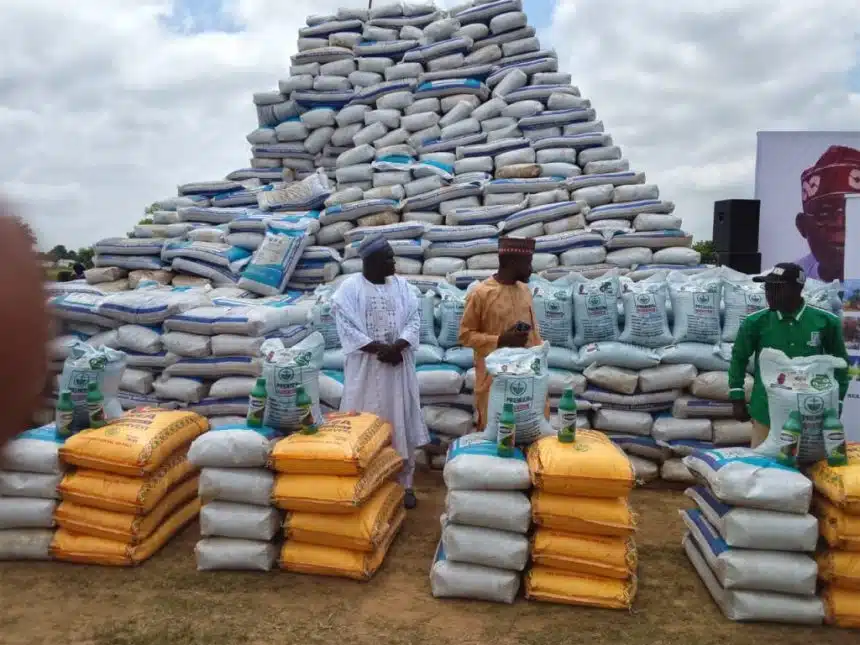

Arzikin Noma has reaffirmed its commitment to advancing Nigeria’s food security agenda through its strategic collaboration with the Federal Government and the Bank of Agriculture (BOA) in the implementation of a nationwide agricultural financing programme designed to boost grain production and empower millions of smallholder farmers.
The partnership supports the Federal Government’s target of increasing Nigeria’s annual grain output to 25 million metric tonnes while providing accessible financing, improved agricultural inputs and technical support to farmers across the country.
Unveiled at the Polo Field in Zaria, the initiative which also serves as the Renewed Hope Smallholder Support and Value Chain Fund is designed to drastically cushion rising food prices by aggressively scaling up the productivity of smallholder farmers nationwide. Under this collaborative framework, Nigeria aims to more than double its annual grain production from the current 11 million tonnes to a massive 25 million tonnes.
The groundbreaking programme targets two million smallholder farmers for its initial expansion, starting with a pilot phase of 500,000 farmers during the current farming season, before eventually scaling up to cover five million farmers across the country. Through this alliance, over 10 million bags of essential farm inputs, including subsidized fertilizers, certified hybrid seeds, and agrochemicals, will be distributed through a single-digit interest financing arrangement.
Speaking on the operational dynamics of the initiative, the Group Managing Director of Arzikin Noma Africa, Mr. Adeoluwa Michael Adeshola, emphasised that private-sector-led execution is the linchpin for achieving true agricultural resilience in Nigeria.
“The best collaboration anywhere in the world is when government provides policy and the private sector delivers implementation. With this partnership, Nigeria can achieve food sovereignty and become a leading exporter of agricultural produce,” Adeshola stated.
Adeshola further explained that the inputs are structured as a revolving credit system to guarantee long-term operational sustainability. He noted that beneficiaries are expected to repay the financing after harvest, which will allow the fund to cycle back and empower even more farmers in subsequent seasons.
He added that local stakeholders are fully aligned to ensure the initiative’s integrity, saying: “Traditional rulers, community leaders, security agencies and other stakeholders have pledged to support the initiative by encouraging beneficiaries to honour their repayment obligations. Timely loan repayment and sustained investment in smallholder agriculture would increase food production, reduce food inflation, improve rural livelihoods and position Nigeria as a leading agricultural hub in Africa.”
Reaffirming the state’s institutional backing, the Minister of Agriculture and Food Security, Senator Abubakar Kyari, underscored the significance of smallholder farmers, who make up 85% of domestic food production despite working on plots smaller than one hectare. He explained that the Tinubu administration’s primary strategy rests on expanding domestic output rather than importing food.
“Food affordability is largely determined by supply and demand. Expanding production through timely access to quality farm inputs remains a key strategy of the Tinubu administration,” Kyari remarked.
The Minister added that approximately two million bags of agricultural inputs would be distributed directly through registered farm aggregators, who will double as extension service providers. Additionally, the government will implement a Guaranteed Minimum Price (GMP) mechanism to insulate farmers from market volatility and ensure they receive fair prices for their produce post-harvest.
Complementing this structure, the Managing Director of the Bank of Agriculture, Mr. Ayodeji Oludare Sotinrin, confirmed that the inputs are being rolled out under the bank’s flexible nine percent lending facility to maintain economic viability. To ensure quality control and maximum yield, BOA carefully vetted and selected 20 specialist farm aggregators out of 1,240 applicants for the pilot phase.
Sotinrin highlighted the massive macroeconomic math driving the partnership: if five million smallholder farmers cultivate one hectare each and hit a baseline yield of five tonnes per hectare, Nigeria will comfortably hit its 25-million-tonne grain target. This volume would comfortably satisfy local consumption, eliminate import dependency, and unlock immense export potential.
Looking ahead, Sotinrin announced that the BOA and Arzikin Noma alliance will soon introduce irrigation financing and “irrigation-as-a-service” options to support dry-season farming and eliminate seasonal income gaps.
He strictly cautioned the beneficiaries against compromising the project: “Utilise the inputs strictly for farming, avoid diversion or resale, and follow the guidance of extension officers to maximise productivity and ensure prompt repayment of the loans.”
The high-profile launch was well-attended by key agricultural stakeholders, women’s groups, and traditional authorities, including the representative of the Emir of Zazzau, the Sarkin Noman Zazzau, Alhaji Aliyu Ibrahim Bamalli. Furthermore, the National President of the All Farmers Association of Nigeria (AFAN), Faruq Mudi Kumo, warmly commended the initiative, calling it a monumental milestone toward delivering the Renewed Hope Agenda’s agricultural vision.