

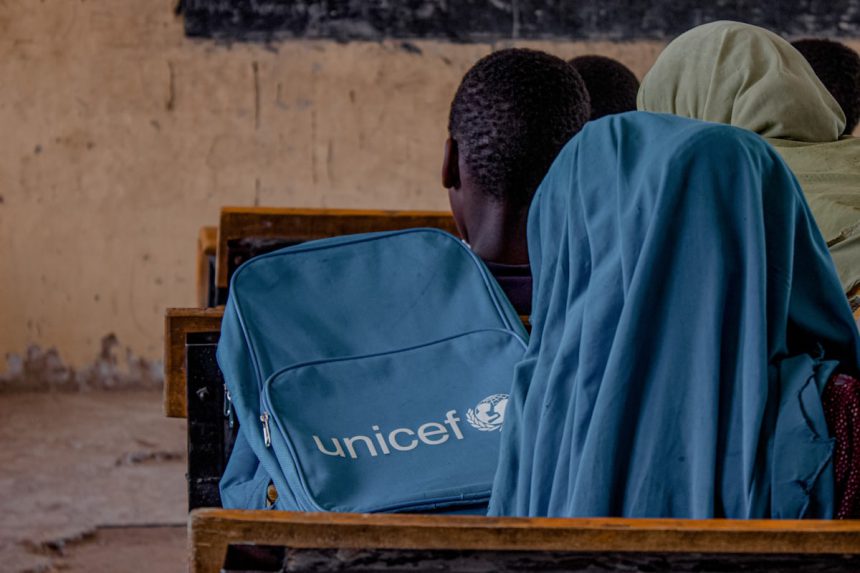

The attention of key Stakeholders in Nigeria’s education sector has been drawn to select digital learning platforms and artificial intelligence (AI) tools that can help in addressing the country’s growing out-of-school children crisis while improving learning outcomes nationwide.
This came into focus during discussions at a two-day Media Dialogue on Digital Learning, Artificial Intelligence and Skills Development for Out-of-School Children, organised by the Osun State Ministry of Education in partnership with the United Nations Children’s Fund (UNICEF), the World Bank and other development partners.
Speaking at the event, Chief of UNICEF Lagos Field Office, Celine Lafoucriere, painted a grim picture of Nigeria’s education challenges, stressing that millions of children are being left behind in an increasingly digital world.
According to her, only one out of every four Nigerian children attending school can read proficiently and perform basic mathematics by the age of 14, while millions of others have no access to education at all.
“Think about that for a second. Of all the children in Nigeria who actually go to school, only one in four can read properly and do basic mathematics at age 14. And we are only talking about children who make it to school. There are millions more who never get to school at all,” she said in a video shared with media stakeholders.
Lafoucriere noted that the statistics represent real children whose futures are being compromised by a lack of access to quality education and skills development.
She warned that as technology and artificial intelligence continue to reshape the global economy, children without access to education and digital skills risk being permanently excluded from opportunities.
“The children who understand how to use these technologies will have a chance to thrive. Those who do not will be left behind. Right now, many out-of-school children in Nigeria are among those being left behind, and girls remain the most disadvantaged,” she stated.
The UNICEF official challenged media practitioners to play a more active role in sustaining public discourse around education, saying consistent reporting could influence policy decisions and attract greater investment in solutions.
“When journalists continue to tell important stories week after week, policymakers listen, politicians listen, and stakeholders pay attention. A story that does not go away is a story that eventually gets acted upon,” she added.
She commended the Osun State Ministry of Education and the State Universal Basic Education Board (SUBEB) for their commitment to improving access to learning opportunities, particularly for vulnerable children.
Earlier, the Permanent Secretary of the Osun State Ministry of Education, Mr. Muritala Adekunle Jimoh, praised UNICEF and other development partners for supporting efforts to strengthen Nigeria’s educational ecosystem.
He described education as the most powerful instrument for social transformation and economic growth, urging stakeholders to intensify efforts to ensure that every child has access to quality learning opportunities.
“I extend our sincere appreciation to UNICEF for its continuous support and commitment to improving access to quality education for every child. This collaboration demonstrates our shared determination to address one of the most pressing educational challenges of our time, the issue of out-of-school children,” Jimoh said.
“Education remains the most powerful form of humanitarian intervention and a catalyst for social transformation and economic development.”
The permanent secretary observed that millions of children worldwide, including many in Nigeria, remain excluded from formal education due to poverty, insecurity, geographical barriers and socio-cultural factors.
He, however, expressed optimism that digital technology and artificial intelligence could help bridge educational gaps and expand access to learning for vulnerable and marginalised children.
“Digital learning platforms are transforming the way knowledge is delivered, making education more accessible, flexible, inclusive and engaging. When responsibly deployed, artificial intelligence can personalise learning experiences, identify learning gaps, support teachers and improve educational planning,” he said.
“As we embrace technological advancement, it is imperative that no child is left behind in the digital transformation.”
Also speaking, UNICEF Education Specialist, Harold Kpojime, described Nigeria’s out-of-school children situation as one of the most severe globally, revealing that about 20 million school-age children are currently outside the formal education system.
“Nigeria has one of the highest numbers of out-of-school children in the world. Approximately 20 million children are out of school, which means nearly one in every three school-age children is not in the classroom,” he said.
Kpojime explained that data presented during the dialogue showed a worrying trend in school retention across the country.
“What we observed is that as children progress from primary school to junior secondary and then senior secondary school, completion rates continue to decline. The dropout rate becomes more significant at the higher levels, which is very alarming,” he stated.
He identified poverty, cultural practices and other socio-economic factors as major contributors to school dropouts, while noting that the South-West region performs better than many other parts of the country in basic education indicators.
“Although the South-West records relatively strong figures at the primary school level, there is still a major challenge with teenagers at the secondary school level, where we see higher dropout rates and lower completion rates,” he added.
The education specialist further highlighted concerns about youth unemployment and the widening digital skills gap among young Nigerians.
“We also reviewed data showing that over 70 per cent of Nigerian youths are unemployed or lack the skills required for available jobs. Even where employers are willing to hire, many young people do not possess the necessary competencies. This is a serious concern,” he said.
To address these challenges, Kpojime said UNICEF and its partners are deploying digital learning solutions such as the Nigeria Learning Passport (NLP) and YOMA, platforms designed to provide curriculum-based learning resources and entrepreneurship skills for young people.
According to him, the Nigeria Learning Passport has been launched in 24 states and currently serves more than 2.34 million users nationwide.
“The platform contains curriculum-aligned resources for learners across different grade levels. It also includes a dedicated section for teacher professional development because improving learning outcomes requires investing in both learners and teachers,” he explained.
Kpojime disclosed that support from partners including IHS Towers, Airtel, Sony and Tecno has enabled the training of teachers in digital literacy, blended learning strategies and artificial intelligence.
He added that more than 2,300 schools have been connected to internet services, while approximately 14,700 tablets have been distributed across the country to support digital learning initiatives.
Despite the progress, he acknowledged that access to digital devices remains a major obstacle.
“The tablets distributed so far are still only a drop in the ocean considering the number of public schools in Nigeria. We need more support from governments, private sector organisations and development partners if we are to scale up these interventions,” he said.
Participants at the dialogue agreed that stronger collaboration among governments, development agencies, private sector stakeholders and the media would be crucial to harnessing digital technology and artificial intelligence to reduce the number of out-of-school children and prepare Nigerian youths for the future workforce.
Other partners involved in the initiative include the Federal Ministry of Education, Universal Basic Education Commission (UBEC), National Commission for Almajiri and Out-of-School Children Education (NCAOOSCE), State Universal Basic Education Boards (SUBEBs), the World Bank, Education Cannot Wait (ECW) and the Global Partnership for Education (GPE).