


swizerland’s Foreign Ministry has confirmed that the woman who tested positive for Ebola in Nigeria is the wife of a Swiss diplomat.
The 42-year-old Ugandan-born woman, who lives in Abuja, tested positive for the virus on October 20, making her Nigeria’s first confirmed Ebola case in more than a decade.
According to the Swiss Foreign Ministry, the woman and her husband travelled to Uganda earlier this month. Her husband is currently in isolation but has not developed any symptoms.
The ministry said all 25 employees of the Swiss Embassy in Nigeria were in good health and did not need to isolate. The embassy, which has eight Swiss and 17 local employees, remains open and operational with health and safety measures in place.
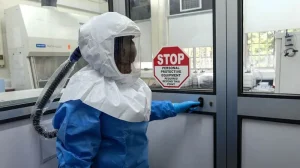
The woman reportedly spent about a week at a private clinic in Abuja after developing symptoms before her infection was confirmed. The World Health Organisation (WHO) said she was receiving treatment in isolation and showing signs of improvement.
She returned to Nigeria on October 3 after spending about two and a half weeks in Uganda. However, health authorities have yet to establish where she contracted the virus.
The Swiss government told Reuters that the woman did not travel to the Democratic Republic of Congo (DR Congo), contradicting earlier accounts from Ugandan officials.
Investigators are also examining whether she may have had contact with a Kenyan man who died of Ebola after travelling through Uganda’s main airport.
The Africa Centres for Disease Control and Prevention (Africa CDC) said a possible interaction between the two patients at Entebbe Airport was among the scenarios being investigated, although no link has been established.
The Kenyan man reportedly travelled from DR Congo through Uganda before arriving in Nairobi on October 3. Kenya has since recorded nine confirmed infections, including the fatal case, with health officials linking the cases to the initial patient.
Despite both the Nigerian and Kenyan patients passing through Entebbe Airport on the same day, authorities have not established whether they met or shared facilities.
The WHO said it was too early to determine the source of the Nigerian woman’s infection, adding that investigators were still reconstructing her travel and exposure history.
Nigeria’s Centre for Disease Control and Prevention is conducting genomic sequencing to determine whether her infection is linked to other cases.
Meanwhile, Nigerian health authorities are tracing additional people who may have been exposed to the patient beyond the 44 contacts initially identified.
Uganda has maintained that it has no confirmed active Ebola cases, while investigations into the source of the Nigerian woman’s infection continue.
The WHO has urged countries in the region to strengthen disease surveillance, investigate suspected infections promptly and protect frontline health workers.
READ ALSO: Ebola: Federal Government Directs 15 States to Intensify Preparedness
Ebola is a severe viral disease transmitted through direct contact with the blood or other bodily fluids of an infected person, or contaminated objects. Symptoms may include fever, severe weakness, vomiting and diarrhoea.
Health authorities say prompt isolation, contact tracing and early treatment are essential to preventing further transmission.