
The Federal Government has granted a waiver on import duties for mass transit buses, electric vehicles, and manufacturing machinery.
The development followed President Bola Tinubu’s directive to key economic officials to design measures to cushion the impact of the ongoing Middle East crisis on Nigerians, particularly amid rising fuel prices.
Special Assistant to the President on Social Media, Dada Olusegun, noted that the move is part of new fiscal measures aimed at easing economic pressure on Nigerians and curbing inflationary pressures.
Olusegun said the Tinubu administration approved a broad set of import duty reductions to lower inflation, support businesses, and improve affordability for consumers.
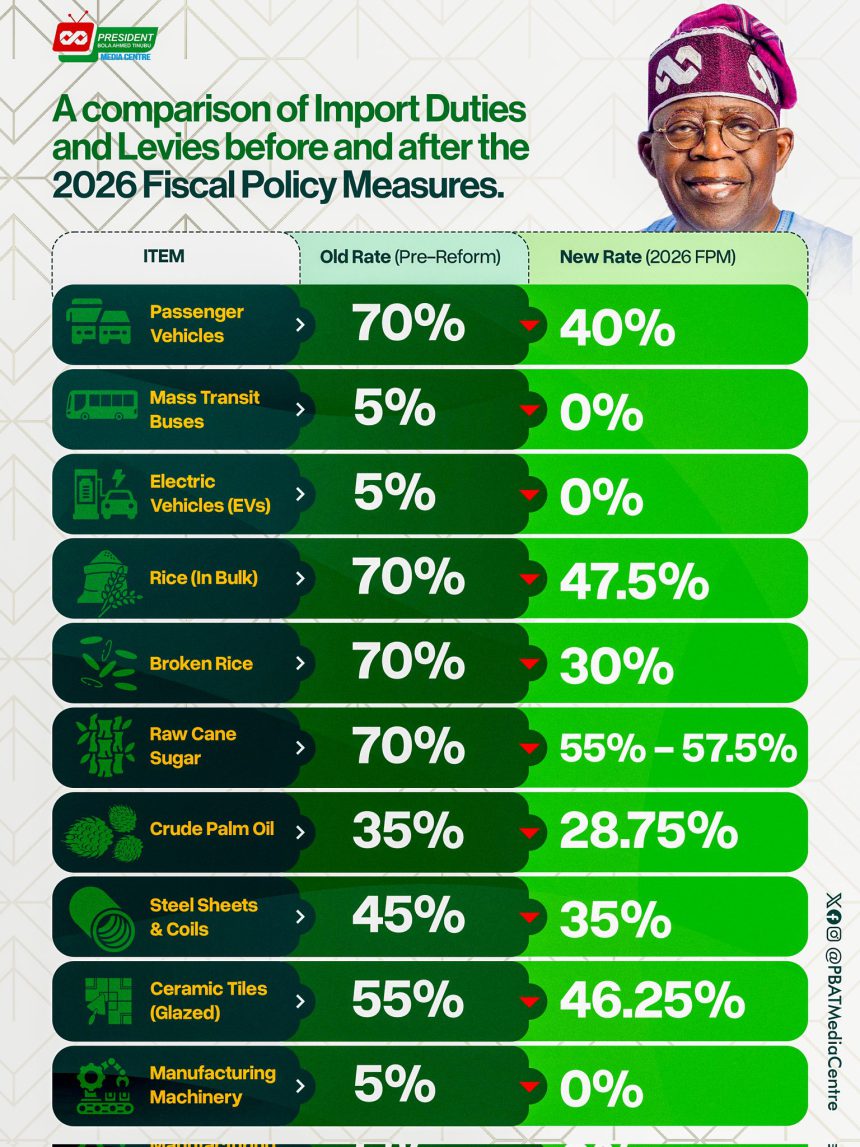
Under the new policy, import duties on electric vehicles were reduced from 5% to 0%.
Mass transit buses were also granted full duty exemption, down from 5% to 0%, to encourage cheaper public transportation and support cleaner mobility alternatives.
The levy on manufacturing machinery was equally scrapped, falling from 5% to 0%, in a move aimed at lowering production costs and boosting industrial activity.
Raw cane sugar was adjusted from 70% to between 55% and 57.5%, while crude palm oil duties were reduced from 35% to 28.75%.
The policy also introduced broader tariff adjustments across key import segments – passenger vehicle duties were reduced from 70% to 40%, while tariffs on bulk rice were cut from 70% to 47.5% and broken rice from 70% to 30%.
In the industrial and construction sector, steel sheets and coils were lowered from 45% to 35%, while glazed ceramic tiles were reduced from 55% to 46.25%, in a move aimed at easing production and construction costs.
A 90-day transition phase beginning April 1, described as a “Transition Phase”, to allow markets to adjust gradually and avoid sudden shocks, has also been introduced.