

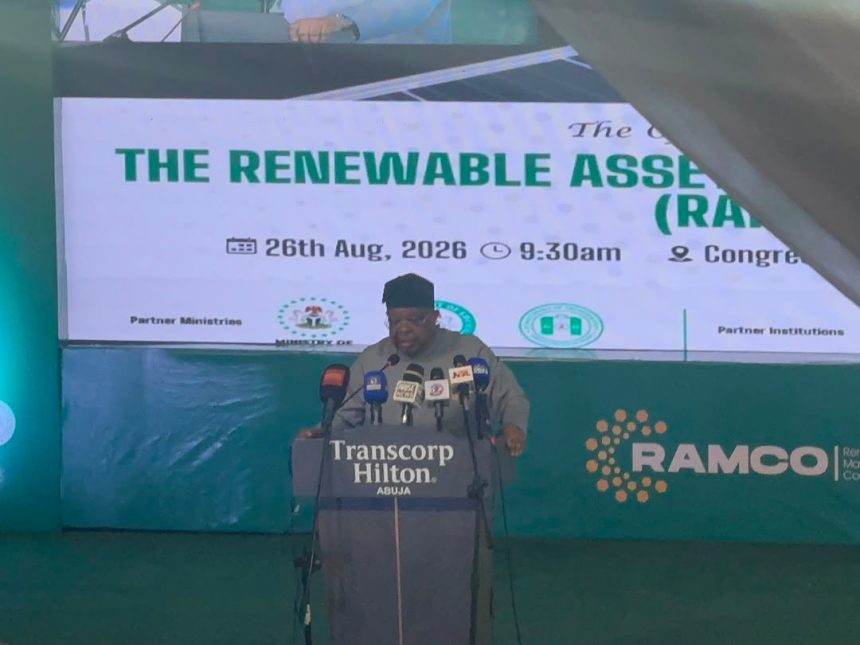

The Federal Government has set a target of 6,500 megawatts (MW) of electricity supply by the end of December 2026, as part of efforts to improve power availability and strengthen the national grid.
The Minister of Power, Joseph Tegbe, disclosed this on Wednesday at the official launch of the Renewable Asset Management Company (RAMCO) in Abuja.
Government targets 8,000MW by 2027
Tegbe said the government also plans to raise electricity supply to 8,000MW by the end of 2027.
He said Nigeria’s current generation capacity stands at approximately 5,000MW, noting that the government is working to improve its ability to transmit and distribute available power.
“We are struggling to wheel 5,000 megawatts today.
My target is that by the end of this year, we’ll conveniently be wheeling 6,500.
By the end of next year, we will be wheeling 8,000 megawatts.”
On the podium right now, the Honourable Minister of Power, Chief Joseph O. Tegbe, delivers his speech at the launch of the Renewable Asset Management Company (RAMCO), highlighting the importance of sustainable energy solutions in strengthening Nigeria’s power sector and ensuring… pic.twitter.com/rTWRAkLl0c
— Yeribaba’s Page 🇳🇬 (@YeriTheSGF) August 26, 2026
The minister said the government would revisit the East and West Super Grid projects to build greater resilience into the national electricity network.
He said the ministry was working to close existing gaps through grid stabilisation, asset optimisation and increased investment in transmission and distribution infrastructure.
Tegbe said the newly established RAMCO would play a central role in the government’s efforts to improve power generation and reliability.
He described the company as a shift away from the traditional approach of acquiring public power assets without adequate long-term management.
According to him, RAMCO will promote professional stewardship, stronger governance and measurable performance in the management of the country’s power infrastructure.
The minister identified three priority corridors for grid stabilisation: the Lagos axis, the Abuja-Kaduna-Kano corridor and the Enugu-Onitsha axis.
He said technical audits are ongoing along the corridors to assess the condition of transmission towers, substations and other installations.
Some of the infrastructure, Tegbe noted, has been in service for more than four decades.
He said the assessments would inform plans to replace ageing equipment and strengthen the reliability of the national grid.