

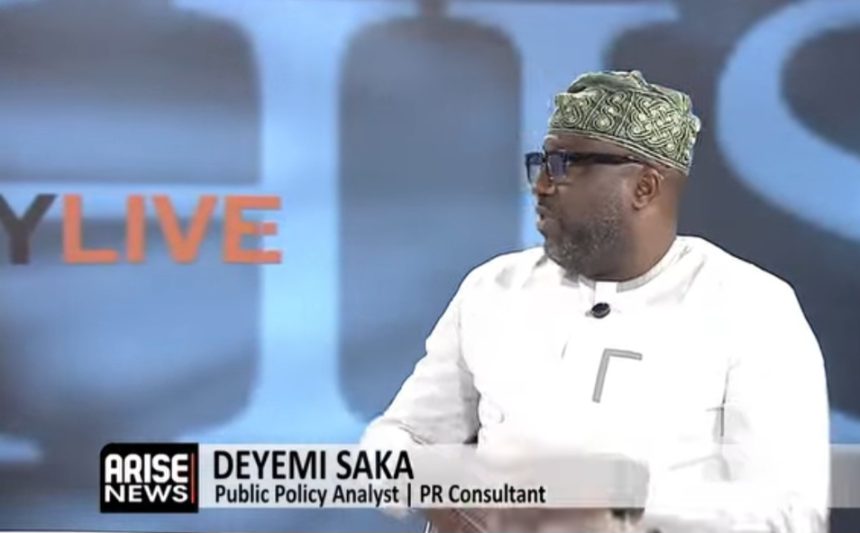

A public policy analyst and public relations consultant, Deyemi Saka, has urged Nigerians to shift attention from recurring debates over President Bola Ahmed Tinubu’s academic credentials and instead focus on evaluating his administration’s performance ahead of the 2027 general elections.
Speaking during an interview on Arise Television, Saka argued that the controversy surrounding Tinubu’s educational qualifications had largely run its course and should no longer dominate political discourse.
According to him, the President’s submission of his university credentials to the Independent National Electoral Commission (INEC) satisfied the constitutional requirements for contesting the presidency.
Saka noted that after studying admission practices in the United States during the 1970s, he found that some institutions admitted students through alternative pathways that did not necessarily require conventional secondary school qualifications.
“I took my time to study what was obtainable in the U.S. in the 1970s. I realised that, in the 1970s in the United States, you probably didn’t necessarily need a secondary school certificate or A-levels to get into an institution,” he said.
He explained that some American institutions operated open enrolment systems, accepted mature students or relied on General Educational Development (GED) examinations for admission, making it possible for individuals to gain university admission through different routes.
Saka maintained that there was no evidence that Tinubu’s university certificate was fraudulent, adding that the relevant document had been subjected to public scrutiny without being proven fake.
“As far as the constitutional requirement is concerned, I think we should move beyond that. There are better issues to hold Tinubu accountable for as we approach the 2027 election, rather than the certificate issue,” he stated.
Addressing concerns over the absence of the President’s primary and secondary school certificates among documents submitted to INEC, Saka argued that the Constitution does not prescribe a specific sequence of academic qualifications that candidates must present.
He recalled the case of a former Speaker of a State House of Assembly who, despite possessing higher qualifications, chose not to submit his secondary school certificate to avoid unnecessary controversy, noting that the decision was never challenged.
According to the analyst, what matters is whether a candidate meets the constitutional requirements laid down by law.
He urged Nigerians to concentrate on assessing the Tinubu administration based on its policies, achievements and shortcomings, rather than revisiting credential-related controversies.
Saka said public debate ahead of the 2027 elections should focus on governance, economic management, security and other issues that directly affect the lives of citizens.