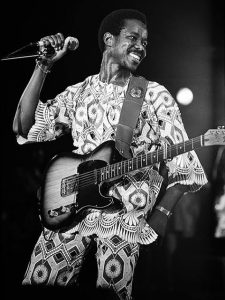


As King Sunny Adé turns 80, the bigger question is no longer how far he took jùjú music, but what happens to the tradition he transformed when the king is no longer on stage.
At 80, King Sunny Adé has earned the right to simply be celebrated. But there is a more difficult question that his birthday inevitably raises: what comes next? More music?!
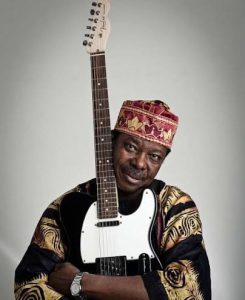
For six decades or more, Sunday Adeniyi Adegeye popularly called King Sunny Ade morphed from just a guitarist into a custodian of Yoruba musical heritage, a restless experimenter, a formidable bandleader and one of the artists who demonstrated that Nigerian music could travel internationally without first stripping itself of its cultural identity.
That is why the title “King of Jùjú” has endured.
He did not inherit the throne merely because he became famous. He built a sound distinctive enough to make the title meaningful. At 80, the story of KSA is as much about the future of Nigerian music as it is about his extraordinary past.
Ade’s decisive transformation began in the 1960s. After gaining experience with Moses Olaiya’s Federal Rhythm Dandies, he established his own group, the Green Spots, in 1967. The band would later evolve through different names, including African Beats and Golden Mercury.
The significance of creating his own band went beyond having another name on a concert poster. It gave Ade the space to construct a musical identity of his own.
He expanded the vocabulary of jùjú by bringing together electric guitars, talking drums and other percussion instruments with sounds that were less familiar within the genre. The pedal-steel guitar became one of his signatures, while synthesizers, vibraphones and other electronic textures subsequently found their way into his arrangements. Yet, the technology never completely overwhelmed the tradition.
His songs remained deeply connected to Yoruba language, praise singing, proverbs, rhythm and oral culture. The talking drum was not decoration; it was part of the musical conversation.
That balance became one of his greatest achievements: modernising the sound without severing its roots.
There was another revolution taking place beyond the recording studio. KSA understood performance. His shows were expansive, energetic affairs involving large ensembles of guitarists, percussionists, singers and other instrumentalists. His musicians did not merely accompany him; they became part of a carefully coordinated musical machine.
The result was a performance culture in which the guitar lines, talking drums, percussion and voices could build, retreat and explode again.
Jùjú was no longer simply music to be heard. It became something to watch. That aspect of his career remains particularly relevant in an era when Nigerian musicians routinely build their brands around elaborate live productions, choreography, large backing bands and arena performances.
It would be simplistic to say contemporary Afrobeats artists simply copied KSA. They operate within a radically different music industry.
But the idea that a Nigerian musician could turn the stage into a large-scale spectacle was hardly invented by the streaming generation. KSA had been doing it for decades.
By the 1970s, his reputation had grown beyond Nigeria. He established his own record label, Sunny Alade Records, in the mid-1970s, giving him greater control over his recordings and business affairs. He also began performing in Britain, with his first UK performance taking place in 1975. Then came 1982. That year changed the scale of the King Sunny Adé story.
He signed with Island Records and released Juju Music, introducing his music to a much wider international audience. The album was followed by Synchro System in 1983 and Aura in 1984.
Synchro System earned a Grammy nomination, making Adé the first Nigerian artist to receive a Grammy nomination.
The Island chapter did not last indefinitely, but its importance did.
KSA had demonstrated that an African musician could enter the international market while retaining Yoruba lyrics and the essential architecture of jùjú.
That achievement now looks less like an isolated event and more like part of the long road to the global Nigerian music industry of today.
It is tempting to draw a straight line from King Sunny Adé to today’s Afrobeats stars.
The reality is more complicated.
Afrobeats has multiple parents: highlife, jùjú, fuji, Afrobeat, R&B, hip-hop, dancehall, electronic music and countless regional traditions. Its modern form was created by generations of musicians, producers and audiences.
His music demonstrated that traditional Nigerian rhythms could absorb foreign instruments and production techniques without losing their cultural identity. His use of multiple guitars, layered percussion and electronic sounds anticipated the kind of genre-crossing that now defines much of Nigerian popular music.
Even the sampling culture surrounding contemporary Nigerian music provides reminders of his enduring catalogue.
Recall that Channels Television reported that Adekunle Gold and Flavour drew from the groove of KSA’s “Ma Jaiye Oni” for “Yoyo“, while American rapper Petey Pablo sampled the rhythm of “Synchro System” for “I Told Y’all”.
The significance is not simply that younger artists have borrowed from him.
It is that the old music remains usable.
A catalogue survives when new generations can find something in it that still speaks to their own musical moment.
There is another dimension to KSA’s legacy that numbers, awards and international tours cannot adequately measure.
His music preserved language and oral traditions.
His songs drew heavily on Yoruba praise poetry, proverbs and forms of verbal expression that predate the recording industry. His jùjú therefore functioned not only as entertainment but also as a vehicle for cultural memory.
That matters in an era when popular music is increasingly consumed through short clips, playlists and algorithmically selected fragments.