

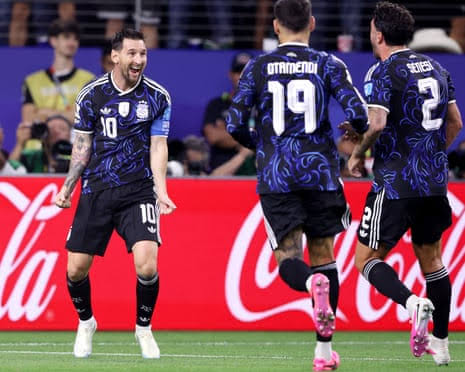

Lionel Messi continued his remarkable World Cup campaign by coming off the bench to score and set another record as Argentina maintained their perfect group-stage record with a comfortable victory over Jordan in Dallas.
With Argentina already assured of top spot in Group J, head coach Lionel Scaloni rested his captain until the hour mark. Messi’s introduction was greeted with thunderous applause from the crowd, and the eight-time Ballon d’Or winner did not disappoint.
The Argentine icon wrapped up the victory 10 minutes from time with a trademark curling free-kick that beat the wall and nestled into the bottom corner.
The strike was Messi’s sixth goal of the tournament, extending his lead in the race for the Golden Boot, while also taking his World Cup tally to a record 19 goals. In doing so, he became the first player in history to score in seven consecutive World Cup matches, further cementing his place among the competition’s greatest-ever performers.
Elsewhere in Group J, Algeria and Austria produced one of the most dramatic finishes of the tournament as a thrilling 3-3 draw sent both nations into the knockout stage while ending Iran’s World Cup dream.
Austria appeared destined for elimination after Riyad Mahrez scored his second goal of the night in the third minute of stoppage time to put Algeria ahead 3-2. At that stage, Iran had moved into the qualification places as one of the tournament’s best third-placed teams.
However, Austria rescued themselves in extraordinary fashion when Sasa Kalajdzic headed home a dramatic equaliser in the 96th minute, sparking wild celebrations among Austrian supporters and ensuring both teams advanced at Iran’s expense.
The result also saw Austria become the first team in World Cup history to avoid defeat after falling behind beyond the 90-minute mark. Iran, meanwhile, exited the competition unbeaten after drawing all three of their group matches, having earlier been denied victory over Egypt by a late VAR offside decision.
In Group K, DR Congo reached the World Cup knockout rounds for the first time after coming from behind to defeat Uzbekistan and set up a last-32 meeting with England.
Uzbekistan made the brighter start and took the lead through Eldor Shomurodov, who capitalised on a defensive mix-up between Axel Tuanzebe and Aaron Wan-Bissaka before calmly lifting the ball over the advancing goalkeeper.
The Central Asians dominated much of the first half, but DR Congo gradually grew into the contest. After seeing a goal ruled out for a foul in the build-up, the African side eventually found their rhythm and completed a comeback that secured a historic place in the knockout phase.
England also progressed after defeating Panama 2-0 to finish top of Group L, with Harry Kane becoming the country’s all-time leading World Cup goalscorer.
After a frustrating opening hour, Jude Bellingham broke the deadlock with a composed finish from Bukayo Saka’s corner before turning provider moments later, delivering a pinpoint cross for Kane to head home his 11th World Cup goal, surpassing Gary Lineker’s long-standing national record.
The victory sends England into a round-of-32 clash against DR Congo in Atlanta. Veteran midfielder Jordan Henderson also marked the occasion by becoming the first England player to appear at four separate World Cup tournaments.
Meanwhile, Colombia finished top of Group K despite being denied a dramatic late winner in a controversial 0-0 draw with Cristiano Ronaldo’s Portugal in Miami.
Davinson Sanchez thought he had secured victory with a stoppage-time header, only for the assistant referee to flag for offside. Television replays showed the defender was ruled offside by the narrowest of margins, prompting strong reactions from players, supporters and pundits.
Former England captain Wayne Rooney criticised the decision, insisting the goal should have stood despite VAR confirming the assistant referee’s call. Although the ruling did not alter the final group standings, it denied Colombia what many believed would have been a deserved victory.
Away from the action on the pitch, Scotland announced the resignation of head coach Steve Clarke following the nation’s group-stage elimination.

The Scottish Football Association confirmed Clarke’s departure shortly after Croatia’s victory over Ghana mathematically ended Scotland’s hopes of progressing as one of the best third-placed teams.
Clarke, who signed a new four-year contract only last month, leaves after guiding Scotland through a disappointing campaign that included victory over Haiti before defeats to Morocco and Brazil.
In an emotional farewell message, the 70-year-old thanked his players for the memories created during his six-year spell in charge, saying they were the foundation of everything the team achieved between 2019 and his departure.