

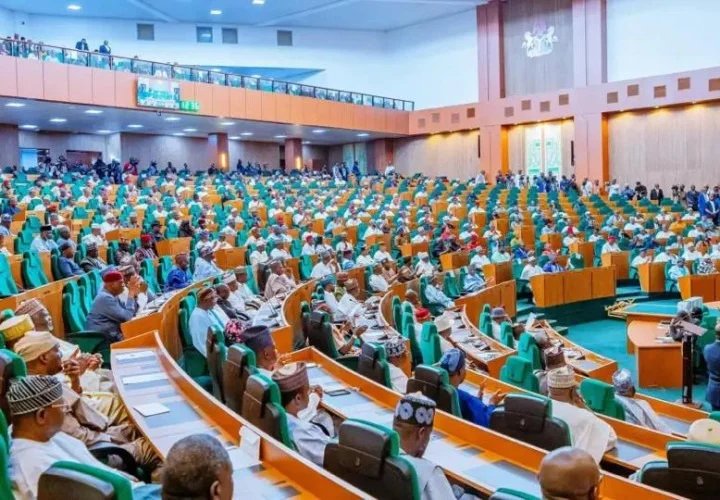

The House of Representatives has commenced consideration of President Bola Tinubu’s executive bill seeking to establish state police, indicating its readiness to adopt the version already approved by the Senate with only minor amendments.
The move marks a significant milestone in the ongoing constitutional amendment process aimed at creating a multi-level policing system to tackle Nigeria’s growing security challenges, including terrorism, banditry, kidnapping and communal violence.
Speaking at a meeting of the House Committee on Constitution Review on Monday, Deputy Speaker and Chairman of the Constitution Review Committee, Benjamin Kalu, said lawmakers would conduct a clause-by-clause review of the executive bill using the Senate-approved version as the committee’s primary working document.
According to Kalu, the House does not expect major differences between both versions of the legislation because they are largely similar.
“The purpose of today’s meeting is to consider the executive bill clause by clause and make appropriate recommendations to the House.
The Senate has already considered and adopted the bill with certain amendments, and copies of that version have been circulated to members. This document will serve as our working draft throughout this exercise,” he said.
He explained that the Senate introduced about eight minor amendments, including provisions covering interpretation, transitional arrangements and implementation of the proposed state police framework.
“You will see the introduction of Section 318 dealing with interpretation, as well as transitional and saving provisions to facilitate the implementation and operationalisation of the state police framework, together with other consequential amendments.
The Senate also introduced about eight minor clauses with slight adjustments that are not too significant,” Kalu added.
The Deputy Speaker recalled that the House had earlier passed its own Constitution Alteration Bill on State Police on June 11 before proceeding on recess.
However, lawmakers reversed that decision on July 14 following the submission of President Tinubu’s executive bill, allowing the House to consider the President’s proposal instead.
“You may recall that before the recess, the House passed the Police Constitution Alteration Bill.
Following the introduction of the executive bill by the President, that decision was rescinded to enable consideration of the new proposal from the Commander-in-Chief,” he stated.
Kalu said President Tinubu, as Commander-in-Chief of the Armed Forces, is well positioned to propose comprehensive constitutional reforms capable of addressing Nigeria’s security challenges.
He also disclosed that the executive bill had already passed first and second readings in the House, while stakeholder engagements held during the National Assembly Open Week effectively satisfied the public hearing requirement.
Describing the legislation as one of President Tinubu’s signature constitutional reform initiatives, Kalu noted that the President had consistently advocated for decentralised policing since his tenure as Governor of Lagos State.
“As Governor of Lagos State, he was among the earliest advocates of multi-layered policing as a strategic solution to Nigeria’s security challenges.
Today, as President, he continues to champion the same cause, demonstrating consistency between his convictions and his actions,” he said.
Kalu stressed that both the executive and legislative arms of government share a common objective of improving national security.
“There is a national consensus that security must remain at the forefront of governance, and both the executive and the legislature are committed to achieving that objective,” he stated.
Kalu further disclosed that the House and Senate were working closely to ensure the constitutional amendment process is concluded without unnecessary delays.