

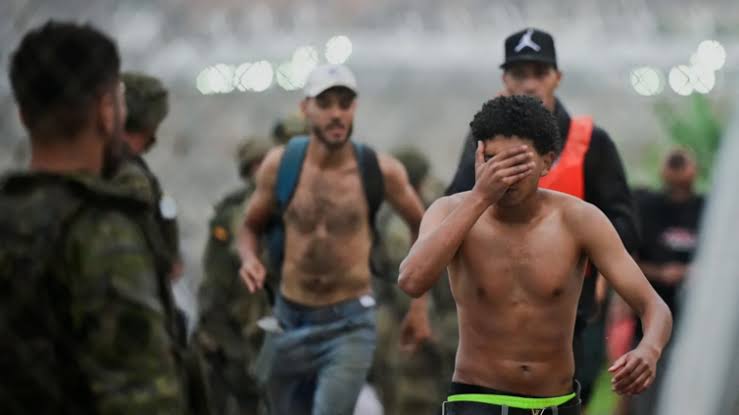

Spain and Morocco on Friday reinforced security along the border of the Spanish enclave of Ceuta after an unprecedented surge saw about 49,000 migrants enter the territory by land and sea within a single day. Authorities also recovered at least 19 bodies from the surrounding waters, highlighting the deadly nature of the mass crossing.
Moroccan security forces deployed water cannon trucks and intensified patrols at border gates to prevent further crossings, while thousands of migrants gathered in the nearby Moroccan town of Fnideq in hopes of reaching Ceuta. Although the main crossing points were effectively sealed, some migrants moved along the coastline searching for alternative routes, with others preparing to swim across. Women, children, Moroccans and migrants from Sub-Saharan African countries were among those attempting the journey.
The aftermath of clashes near the border left a bus and seven vehicles burned, while Spanish authorities announced plans to swiftly return those who entered illegally. However, officials said deportations would comply with a recent Spanish court ruling that limits the use of immediate “border rejection” procedures for migrants intercepted while attempting to reach Ceuta or Melilla.
Spanish Prime Minister Pedro Sánchez was scheduled to visit Ceuta alongside Interior Minister Fernando Grande-Marlaska as the government responded to what it described as the country’s most severe migration crisis since at least 2021. Ceuta and Melilla, Spain’s two autonomous cities in North Africa, are the European Union’s only land borders with Africa and have frequently experienced migration surges, though officials said the latest influx was without precedent.
Territorial Policy Minister Ángel Víctor Torres suggested that a recent Spanish Supreme Court ruling may have contributed to the increase. The court held that migrants intercepted at sea while trying to reach Ceuta or Melilla cannot automatically be returned under Spain’s special border procedures. Torres stressed that the government would continue returning migrants where legally possible while respecting judicial rulings and human rights obligations.
Spain’s Guardia Civil police association (AUGC) criticised the response to the crisis, saying there were too few officers deployed to effectively monitor the border fence during Thursday’s surge. Local migrant rights organisations also called for a comprehensive review of Spain’s migration policies, arguing that Ceuta lacks the resources needed to adequately receive migrants and refugees while protecting their dignity and rights.
The crisis has reignited tensions across Europe over migration policy. Italian Prime Minister Giorgia Meloni warned that Italy could consider extraordinary measures, including suspending participation in the Schengen border-free area with Spain, to protect its borders if migration pressures continue. Italian Foreign Minister Antonio Tajani also criticised Spain’s decision to grant citizenship opportunities to more than 500,000 undocumented migrants, claiming it could encourage human trafficking.
Spain strongly rejected Italy’s criticism. Foreign Minister José Manuel Albares described Tajani’s remarks as “inappropriate,” insisting that Spain expected solidarity rather than political rhetoric from its European partners. Albares said Madrid would summon the Italian ambassador to formally protest the comments.
The latest developments underscore growing pressure on European governments to balance border security with humanitarian obligations as migration continues to shape political debate across the continent.