

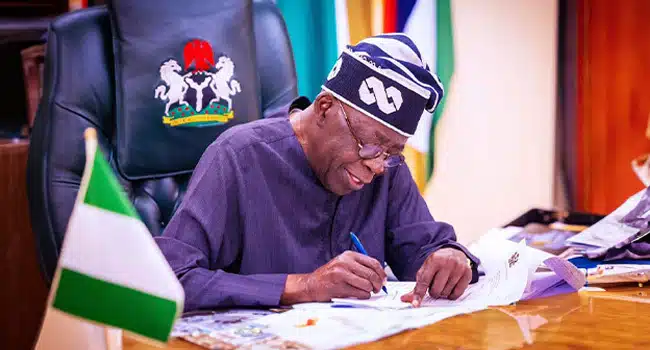


President Bola Tinubu has signed the Executive Order on Virtual Assets Coordination, 2026, to harmonise the regulation of virtual assets which takes effect immediately.
Virtual Assets Coordination, 2026, is aimed at strengthening cooperation among financial, revenue and capital markets agencies, protecting citizens from fraud, and safeguarding the integrity of the financial system while enabling responsible innovation.
Tinubu’s media aide Bayo Onanuga in a statement explained that the order responds to a regulatory environment that has become fragmented as virtual assets increasingly blur the traditional boundaries between currencies, money, commodities and securities.
He noted that the country has been exposed to risks, including money laundering, terrorism financing, cybersecurity, data privacy threats, fraud and The Order is designed to close these gaps through supervisory coordination, without introducing new layers of regulation.
the Order establishes a Virtual Asset Council, chaired by the Central Bank of Nigeria (CBN), with the Nigeria Revenue Service (NRS) and the Securities and Exchange Commission (SEC) as vice-chairs, and comprising the Nigerian Financial Intelligence Unit (NFIU) and the Office of the National Security Adviser (ONSA).
the Council would provide policy direction, promote synergy among the participating agencies, and work with the Attorney-General of the Federation to develop a harmonised legal and institutional framework that aligns the sector with Nigeria’s national security, economic and social objectives.
the presidency also disclosed that the Nigerian Revenue Service will release a tax policy for the virtual assets sector.
It explained that the policy operationalises Nigeria’s tax laws as they apply to virtual assets, providing greater certainty for taxpayers and service providers, strengthening voluntary compliance, and ensuring that the sector contributes fairly to national revenue as it grows.