

The United Nations Children’s Fund (UNICEF) has warned that children without birth registration risk being excluded from essential services and social protection systems, stressing that legal identity is the foundation for accessing basic rights throughout life.
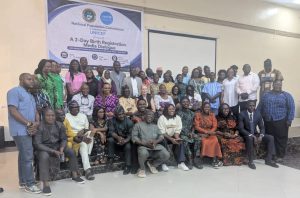
The Chief of UNICEF Lagos Field Office, Celine Lafoucriere, gave the warning during the opening of a 2-day birth registration media dialogue organised by the National Population Commission (NPC), in collaboration with UNICEF, to strengthen advocacy for the registration of children under one year.
The dialogue brought journalists from across the South-West together to discuss the importance of civil registration and the role of the media in encouraging parents and caregivers to register their children from birth.
Lafoucriere described birth registration as a fundamental right of every child, noting that the absence of legal identity could affect access to education, healthcare, social protection and other rights as the child grows into adulthood.
“Birth registration, civil registration is the child’s identity and it is the foundational right of every child’s rights. Without that right, nothing else can happen,” she said.
According to her, a child without an identity may face difficulties accessing school and healthcare and could eventually encounter challenges exercising other rights, including voting and inheritance.
She also drew attention to the connection between birth registration and Nigeria’s social protection system, warning that children who are not formally registered are effectively invisible to government planning and intervention programmes.
“If your child doesn’t have an identity, he does not exist. He or she does not exist on the social register,” Lafoucriere said.

She explained that the absence of accurate registration data could also affect government budgeting because social protection programmes are planned and funded based on the number of people eligible to benefit from them.
Lafoucriere therefore urged journalists to take the message of birth registration to communities, particularly families who are vulnerable or isolated, and help them understand where and how they can register their children.
She said registration was increasingly being made accessible through primary healthcare centres and community facilities equipped with digital devices for the process.
“You are the closest to the families. You are the ones who tell the stories the way they are,” she told journalists, urging them to use real-life experiences of children and mothers to demonstrate the importance of legal identity.
The UNICEF official stressed that the organisation could not achieve the desired improvement in birth registration without the active participation of journalists and other stakeholders.
The State Director of the National Population Commission in Lagos, Abiola Kekere-Ekun, also called for stronger media support to amplify the commission’s efforts in improving birth registration and legal identity for children.
He said greater public awareness was necessary to ensure that parents understood the importance of registering their children and took advantage of available registration points.
Meanwhile, a UNICEF Child Protection Specialist, Dennis Onoise, meanwhile, outlined some of the challenges affecting birth registration in Nigeria and identified legal reform, digitisation, decentralisation, stronger data systems and community mobilisation as critical areas requiring attention.
Onoise said the transition from predominantly manual registration to digital processes would help improve efficiency and make registration easier to access.
He also stressed the need for closer collaboration between the NPC and primary healthcare facilities, arguing that health institutions were strategically positioned to support birth registration because they interact directly with families during pregnancy, childbirth and early childhood.
According to him, decentralising registration services would reduce the burden on families and officials who currently have to travel long distances to access certain services.
He also identified community mobilisation as one area where the media could make an immediate difference by continuously educating families about the benefits of birth registration.
Onoise urged journalists to make birth registration a recurring issue in their reporting rather than treating it as a one-off campaign, noting that sustained public education could help make registration part of the culture surrounding childbirth.
The dialogue also highlighted efforts by UNICEF and its partners to strengthen Nigeria’s civil registration and legal identity system through greater coordination among relevant institutions.
With millions of Nigerian children still requiring formal registration, UNICEF and the NPC are urging government institutions, health workers, community leaders and the media to make birth registration a priority.