

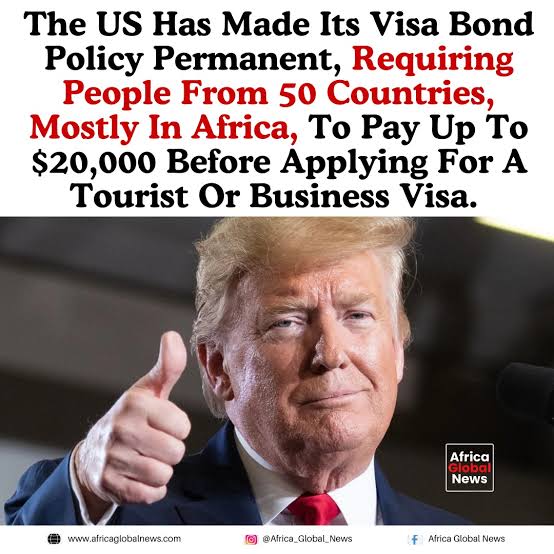

The United States has announced that certain applicants for B-1/B-2 business and tourist visas may be required to post a refundable bond of up to $20,000 before their visas are issued.
According to a federal notice published by the U.S. Department of State, the policy expands a pilot programme introduced in 2025 and is designed to improve compliance with U.S. immigration laws.
Under the new measure, consular officers will have the discretion to require eligible applicants from designated countries to post a bond as a condition for visa issuance. Travellers who comply with the terms of their visas and depart the United States within the authorised period will have their bonds refunded.
The notice states:
“Consular officers may require covered nonimmigrant visa applicants to post a bond of up to $20,000 as a condition of visa issuance, as determined by the consular officers.”
It added that data from the 2025 pilot programme showed that visa bonds are an effective tool for improving compliance among nonimmigrant visa holders.
Applicants selected for the programme will be required to complete the Form I-352 issued by the Department of Homeland Security. However, the U.S. government advised applicants not to submit the form or make any payment unless specifically instructed by a consular officer.
The policy applies to nationals of 50 countries, including Algeria, Angola, Bangladesh, Benin, Botswana, Burundi, Cabo Verde, Cambodia, Côte d’Ivoire, Cuba, Djibouti, Ethiopia, Fiji, Gabon, The Gambia, Georgia, Grenada, Guinea, Guinea-Bissau, Kyrgyz Republic, Lesotho, Malawi, Mauritania, Mauritius, Mongolia, Mozambique, Namibia, São Tomé and Príncipe, Senegal, Seychelles, Tajikistan, Tanzania, Togo, Tonga, Tunisia, Turkmenistan, Tuvalu, Uganda, Vanuatu, Venezuela, Zambia and Zimbabwe, among others.
Notably, Nigeria is not included on the list of countries whose nationals may be required to post the visa bond under the current programme.
The U.S. government said the requirement will apply only to applicants who are specifically directed by a consular officer and does not affect all B-1/B-2 visa applicants.