

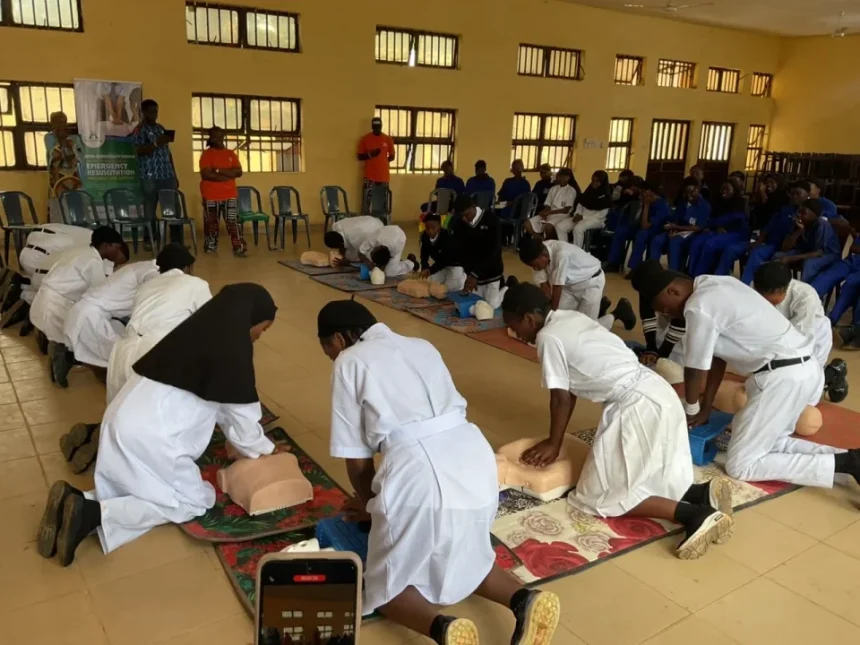

Amid concerns over sudden collapses and deaths, about 60 students of Government Science Technical College, Garki, Abuja, have received training in cardiopulmonary resuscitation and basic life support.
The training was organised by City Club Abuja as part of its Corporate Social Responsibility programme to equip young people with practical skills for responding to medical emergencies before the arrival of professional help.
Speaking during the programme, the President of City Club Abuja, Oluwasanmi Ajayi, said the initiative was part of the organisation’s commitment to giving back to society through practical interventions. He explained that while the club had previously focused its CSR activities on supporting orphanages and other charitable causes, it decided to introduce skills-based initiatives that could have a wider impact.
Ajayi said the club would extend the CPR and basic life support training to other schools, noting that its CSR activities are held every three months. He added that the organisation, established in 2019, had also undertaken interventions such as visits to motherless babies’ homes and the provision of waste bins at Wuse Market, Abuja.
The Chairman of the Board of Trustees, Deji Adetuberu, said the training was prompted by the increasing number of emergencies involving people who suddenly collapse, noting that many members of the public lack the knowledge to provide immediate assistance.
According to him, training students could create a wider chain of knowledge-sharing, as the beneficiaries could pass the skills to their parents, siblings, friends and members of their communities. He added that the club was considering extending the programme to other groups, including journalists.
Also speaking, the Head of the Cardiology Unit at the National Hospital, Abuja, Dr. Oladipupo Fasan, said the training was designed to provide students with basic survival skills that could help save lives during emergencies.
Fasan explained that participants were taught how to respond to an unconscious person and provide immediate assistance before medical professionals arrive or the victim is transported to a healthcare facility. He also raised concerns about out-of-hospital cardiac arrests, noting that many such emergencies occur in places where immediate medical assistance may not be available.
The cardiologist also stressed the importance of public awareness and preventive measures against cardiovascular diseases, identifying hypertension as a major risk factor. He said recent studies indicated that almost 40 per cent of Nigerians were hypertensive, while also advocating greater availability of automated external defibrillators in public places to support emergency response.
The initiative was welcomed by the students, with an SS3 student, Igwe Chimamanda, saying the training had taught her how to respond when someone collapses. Chimamanda, who expressed an interest in becoming a cardiologist, said the knowledge could help her assist family members, strangers and others within her community during emergencies.
Another student, Awelewa Elijah, said the training could help reduce panic and misinformation during medical emergencies. He called for basic life support education to be introduced in schools across the country.
The training comes against the backdrop of reported cases of sudden collapse and death involving young people in Nigeria and elsewhere. In April 2026, a 500-level student of Covenant University, Toluwase Jesutunmise, died after collapsing during a football training session, while Nigerian boxer Segun Olanrewaju died after collapsing during a bout in Ghana in March 2025.
City Club Abuja said it plans to sustain the initiative and extend CPR and basic life support training to more schools as part of its recurring CSR programme.