

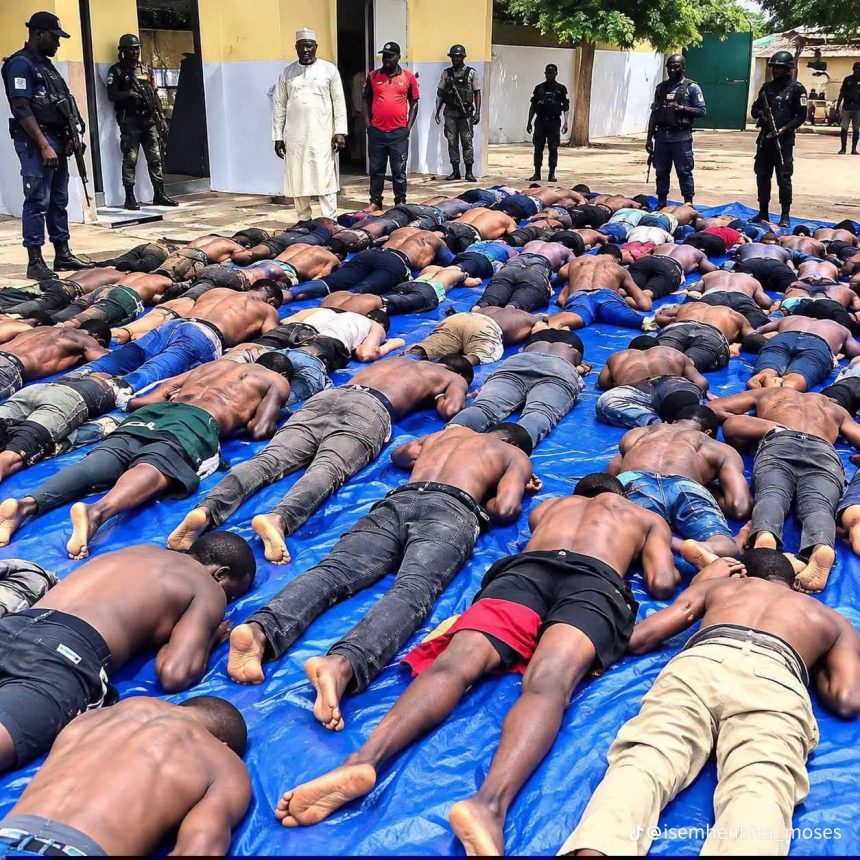

They banged on the door until their hands gave out. They screamed until their throats burned. They shouted that men were suffocating, that men were dying, that they could not breathe. And according to those who lived to tell the story, the officers of the Nigeria Security and Civil Defence Corps (NSCDC) heard them and did nothing.
Thirty-seven people are dead. At least. The exact number is already in dispute, which tells you nearly everything you need to know about how seriously the Nigerian state takes the lives of poor men arrested for allegedly digging for gold.
Shehu, a survivor from Allawa in Shiroro Local Government Area, was one of 65 suspected illegal miners crammed into a cell at the NSCDC office in Minna, Niger State, on September 15 and 16. For three days, they remained in custody. For three days, their families brought them food and begged for their release. And then, on Thursday, the families arrived with food again — only to learn that the men they were feeding were already dead.
Read Shehu’s account and try to remain unmoved: “All of a sudden, we realised that we could not breathe and we were all struggling for where to get fresh air. We even appealed to the officers several times; we banged the cell door but they refused to answer us. Even when we raised the alarm that some people were being suffocated, nobody answered us. They were watching us gasp for breath and screaming for help but they ignored us.”
Screaming for help while the people paid to guard you watch you die. If that is not a crime, then the word has no meaning in Nigeria.
The survivors’ stories are a catalogue of horrors that should make every Nigerian’s blood run cold. Detainees drank their own urine because they were denied water. Men were packed into a room so small and so hot that 17 initial occupants begged for relief, and were answered with more bodies. One survivor said he lived only because he happened to be near the entrance, where the air was slightly less lethal. A substance that smelled like perfume was allegedly sprayed into the cell, and men began collapsing. Another survivor, speaking in Hausa, told the governor and the Minister of Interior that when they begged for water, they were told no one would open the door that night. The door stayed shut. Men died.
Then there are the families. Musa Abdullahi brought food to his son Salim for three days and pleaded with the NSCDC to release him. On Thursday, he came back expecting to see his boy alive. Instead, he found a corpse and a wall of official silence. “What is the reason for killing my son and the others?” he asked. “They should tell us what truly killed our children. Was it that they poisoned or tear-gassed them? We need justice.” Babao Natsira lost his 17-year-old brother, Saleem. He says the family had already completed the paperwork for release. The NSCDC refused to grant bail. Now his brother is dead, and the authorities want him to believe it was a disease, a disease, he notes, that somehow killed dozens of detainees without sickening a single guard. “They killed our children and brothers,” he said.
He is not wrong to be suspicious. The explanations offered so far are not merely unsatisfying; they are mutually contradictory. The NSCDC blamed a disease outbreak but could not name the illness. Survivors described suffocation and dehydration. Governor Mohammed Bago then announced that preliminary forensic findings showed foam mixed with bloodstains in the mouths of some victims and peeling skin signs, he said, pointing toward methane, cyanide or lead poisoning. Three official theories, zero answers, and 37 bodies in a morgue that families are reportedly not allowed to see. Abdullahi’s demand is simple and devastating: let us see the bodies, let an independent autopsy determine what killed our children, so that we can be sure they were not shot, tortured or quietly disposed of.
That the families even have to ask these questions is the indictment. In a functioning state, the deaths of 37 people in custody would trigger immediate arrests, immediate transparency, and immediate accountability. Instead, we have the familiar choreography of Nigerian tragedy management. The state commandant was suspended, then detained in Abuja along with 21 other officers, including the arresting officer, the investigation officer, the legal unit head, the intelligence head, the mining unit head, and the officer in charge of the cell. President Bola Tinubu ordered a “comprehensive investigation.” The Minister of Solid Minerals deployed a “high-powered team.” The Inspector-General of Police pledged to investigate. The Interior Minister made a speech about bouncing back. Everyone is investigating. Nobody has yet been charged. And the corpses are still not being released to the families.
Let us be clear about what accountability would look like, because the official response is carefully designed to avoid it. Detaining officers is not the same as prosecuting them. A “high-powered team” is not the same as an independent inquiry. A presidential statement affirming that suspects retain the right to life and dignity is not the same as a single person being held responsible for violating it. The African Action Congress’s Omoyele Sowore has called for the officers involved to face murder charges if evidence shows the deaths were deliberate or premeditated. Former Vice President Atiku Abubakar has demanded an independent probe and insisted that families deserve clear answers. These are the minimums, not the maximums. The maximum would be a Nigeria in which a man arrested for illegal mining is not sentenced to death by ventilation in a holding cell, with no judge, no hearing, and no appeal.
It is worth pausing on who these men were. They were not armed bandits. They were not insurgents. According to survivors, many were displaced from their homes in Allawa by bandits and had come to Minna to scratch a living from the earth. They carried no weapons. They were arrested for the crime of being poor in a country that criminalizes poverty while doing almost nothing to protect the poor from the violence that drove them from their homes in the first place. The Nigerian state failed to keep them safe in Allawa. It then arrested them in Minna and failed to keep them alive in its own custody. There is no version of this story in which the state is not culpable.
The unrest that followed, the protests, the vandalism, the attacks on government and party offices, the looting, the 24-hour curfew is what happens when grief meets a wall. Minna’s anger did not come from nowhere. It came from three days of families begging outside a facility while their loved ones died inside it. It came from the realization that the men who allegedly watched detainees gasp for breath were still drawing salaries, still wearing uniforms, still shielded by institutions that treat investigations as a substitute for justice. The governor says vandals hijacked the protests. Fine. But vandals do not create the conditions for rage; official negligence does.
What happened in Minna is not a mystery. It is not a disease outbreak that conveniently targeted only the detained and spared only those near the door. It is not a riddle awaiting forensic confirmation. It is a straightforward case of men placed in a poorly ventilated cell, allegedly denied water, allegedly ignored as they screamed for help, and left to die. The only questions that matter now are who gave the orders, who heard the screams and did nothing, who refused to open the door, and who decided that 37 families could be fed a rotating menu of excuses while their sons and brothers lay dead on a light-green tarpaulin.
The President says government will not tolerate mass deaths arising from official negligence. Then prove it. Not with a probe that reports to the same ministry whose officers are accused. Not with suspensions that quietly become retirements. Not with a curfew designed to restore order rather than deliver justice. Prove it with independent autopsies the families can trust, with the immediate release of the bodies, with prompt and public prosecutions, with convictions, and with a fundamental reckoning about how Nigeria detains its poorest citizens.
Thirty-seven men reportedly screamed for help in a Nigerian government cell, and the people outside allegedly did nothing. If that does not produce consequences, then the Nigerian state has told its citizens something they already suspected: that their lives are worth less than the institutions that failed them. Shehu survived. He is alive to tell us what he heard. The question now is whether anyone with the power to act will listen any better than the men who stood outside that door.
What is there to hide?