

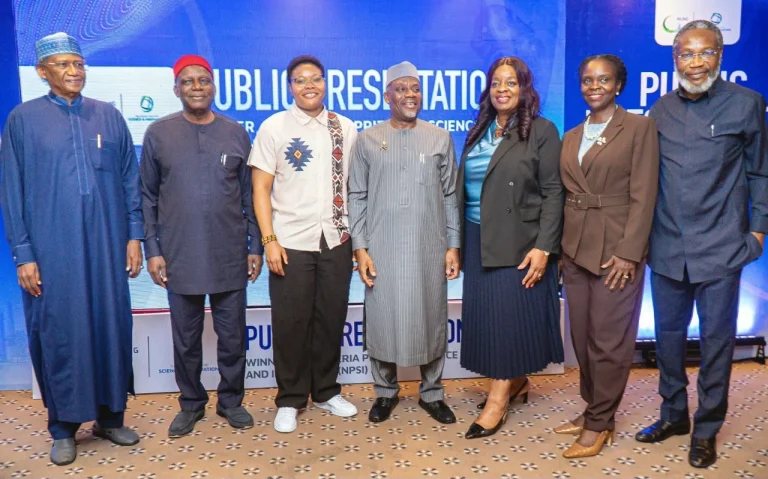

Nigeria LNG Limited has presented GenScan AI, an artificial intelligence-powered medical imaging innovation developed to potentially reduce magnetic resonance imaging (MRI) scan times by up to 90 per cent while maintaining or improving image quality.
The Manager, Corporate Communications and Public Affairs, NLNG, Anne-Marie Palmer-Ikuku, disclosed this in a statement obtained by our correspondent on Tuesday following the presentation of the innovation to stakeholders in Abuja.
Developed by Mary-Brenda Akoda, GenScan AI emerged as the winning entry of the 2026 Nigeria Prize for Science and Innovation, sponsored by NLNG. The innovation uses the C-MORE algorithm to reconstruct MRI images through a one-step framework without requiring new MRI hardware.
According to NLNG, the technology could help healthcare providers attend to more patients, reduce waiting times and improve the utilisation of existing MRI equipment, particularly in areas where access to advanced diagnostic services remains limited.
Speaking at the presentation, NLNG’s General Manager, External Relations and Sustainable Development, Sophia Horsfall, said the company was interested in ensuring that scientific research translated into practical improvements in people’s lives.
“Our interest goes beyond recognising an outstanding idea. We want to see scientific research make a practical difference in people’s lives,” Horsfall said.
She noted that GenScan AI offered the prospect of faster medical imaging and better utilisation of existing equipment, adding that the stakeholder engagement would help determine what was required to move the innovation towards practical application.
Horsfall stressed the importance of accurate diagnosis to effective treatment, noting that diagnostic imaging provides medical teams with evidence needed to identify health conditions and make informed decisions about patient care.
A member of the Prize’s Advisory Board, Professor Barth Nnaji, said GenScan AI stood out because of the strength of its science and its potential to address a practical healthcare challenge.
Nnaji said further engagement with clinicians and other stakeholders would be necessary to determine how the technology could be safely and effectively deployed, adding that the presentation provided an opportunity to assess its potential and requirements for further development.
Akoda emerged as the 2026 winner from a record 237 entries submitted under the theme, “Innovations in Artificial Intelligence, ICT and Digital Technologies for Development.”
Her selection followed an independent evaluation by the Panel of Judges, chaired by Dr Omobola Johnson, and subsequent endorsement by the Advisory Board. She is the first woman and first millennial to win the prize as an individual recipient and is expected to receive the $100,000 award at the Grand Award Night on October 9, 2026.
MRI is widely used in diagnosing conditions affecting the brain, spine, joints and internal organs, but examinations can be lengthy, while the cost of acquiring and maintaining MRI equipment can limit access to the technology.
If validated for clinical use, GenScan AI could enable healthcare facilities to increase the number of patients examined with existing scanners without requiring additional MRI hardware.
However, the technology would require further testing and validation before routine clinical deployment, including assessments of its safety, reliability and suitability for different diagnostic applications.
The Abuja presentation brought together stakeholders who could contribute to the evaluation and potential deployment of the innovation, as NLNG seeks to connect scientific research with practical solutions to development challenges in Nigeria.