

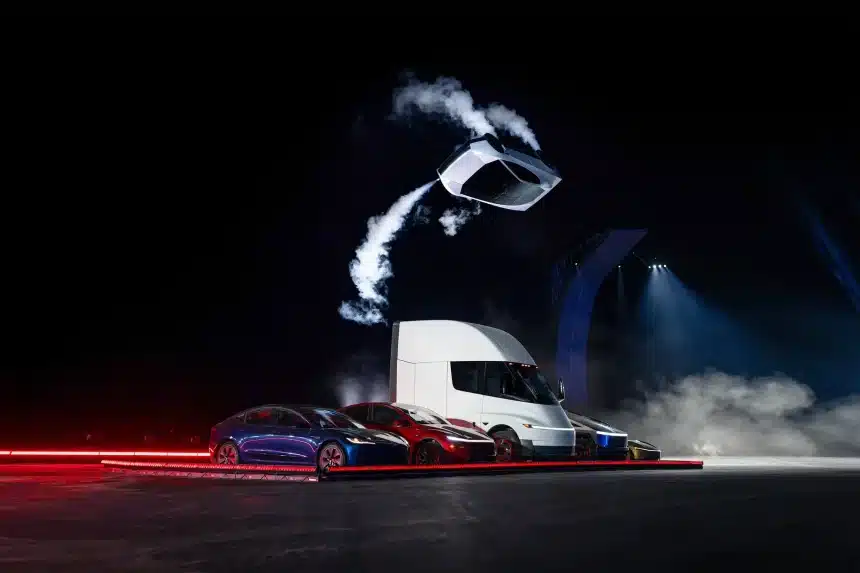

Tesla has unveiled a prototype of its new Roadster sports car featuring rocket technology that allows it to briefly rise into the air, with production targeted for 2028.
According to CNN, the demonstration took place on Thursday at a SpaceX testing facility in Texas, United States, where the two-seater vehicle performed several manoeuvres, including driving upside down before making a brief airborne movement.
The prototype was operated without a driver during the test. Tesla and SpaceX chief executive Elon Musk said the decision was taken “to make sure we don’t kill anyone”, acknowledging the risks associated with the experimental technology.
CNN reported that the vehicle uses 10 nozzles and high-pressure air tanks to generate thrust, with Musk claiming it could accelerate from zero to 60 miles per hour in less than a second.
Musk attributed the development to collaboration between Tesla, the electric vehicle manufacturer, and SpaceX, his rocket company. He described the project as the product of combining the expertise of what he called the world’s best car and rocket companies.
He also told spectators that their presence would help demonstrate that the unusual display was genuine, encouraging them to share what they had witnessed.
Despite the demonstration, questions remain about the Roadster’s ability to achieve sustained flight and whether the technology could be adapted for practical everyday transportation.
Roger Conner, curator for vertical flight at the Smithsonian’s National Air and Space Museum, told CNN that combining the engineering requirements of road vehicles and aircraft presented significant challenges.
He explained that aircraft must be extremely lightweight, while road vehicles require additional structural features, including bumpers and crumple zones, to protect occupants during collisions.
Conner warned that a hybrid vehicle could struggle to perform effectively both on roads and in the air while also carrying a high price tag. He questioned whether the Roadster’s demonstration could be classified as actual flight, describing the movement as a brief hop rather than sustained airborne travel.
However, Jim Dukhovny, chief executive of flying-car startup Alef, told CNN that the technology was feasible, although transitioning safely from vertical take-off to forward flight remained a major engineering challenge.
He stressed that such vehicles must maintain lift and stability throughout the transition to prevent accidents.
CNN also reported that Alef’s prototype weighs approximately 254 pounds, uses eight propellers and is designed to carry one person.
Musk said Tesla planned to begin production of the new Roadster in 2028. However, the latest demonstration has yet to establish whether the vehicle can function as a practical flying car beyond controlled testing conditions.
The unveiling underscores Musk’s ambition to push Tesla’s automotive technology beyond conventional electric vehicles, although questions surrounding safety, engineering, cost and everyday usability remain unresolved.