

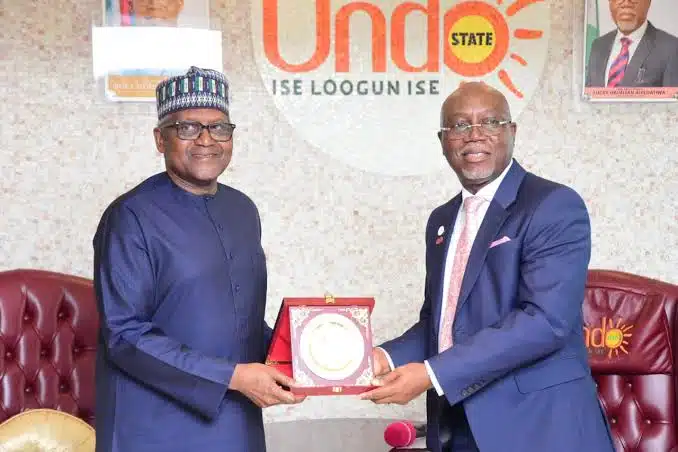

President of the Dangote Group, Aliko Dangote, has announced plans to develop a multi-billion-dollar deep-sea port and industrial hub within the Olokola Free Trade Zone (OKFTZ), a sprawling economic corridor located along the coastal areas of Ondo and Ogun states.
The project, which is expected to become Nigeria’s largest and deepest seaport, will feature dedicated power, gas and water infrastructure aimed at attracting manufacturers and easing the challenges associated with doing business in the country.
Dangote disclosed the initiative during a courtesy visit to Ondo State Governor Lucky Aiyedatiwa in Akure on Monday, describing the proposed development as more than a conventional free trade zone.
According to the billionaire industrialist, the hub will provide investors with critical infrastructure, including electricity, water and logistics services, enabling businesses to commence operations without the delays and costs often associated with securing basic utilities.
He noted that the initiative forms part of a broader investment framework encompassing power generation, gas infrastructure, industrial manufacturing and cement production. Dangote added that the project is designed to tackle Nigeria’s chronic electricity shortages, which he identified as the greatest impediment to industrial growth over the past three decades.
“Most manufacturers currently rely on self-generated electricity. The absence of reliable power has significantly slowed industrial expansion across the country,” he said, explaining that the new industrial model would incorporate a dedicated energy supply system.
Dangote recalled that earlier attempts to develop investments in Olokola were hindered by operational challenges, prompting the group to concentrate much of its industrial activities in Lagos.
However, he expressed optimism that the renewed engagement with the Ondo State Government would pave the way for successful implementation, citing improved conditions and stronger prospects for collaboration.
The proposed project is expected to boost manufacturing, create jobs and enhance Nigeria’s capacity for exports, while further positioning the Olokola axis as a strategic industrial and logistics hub in West Africa.