

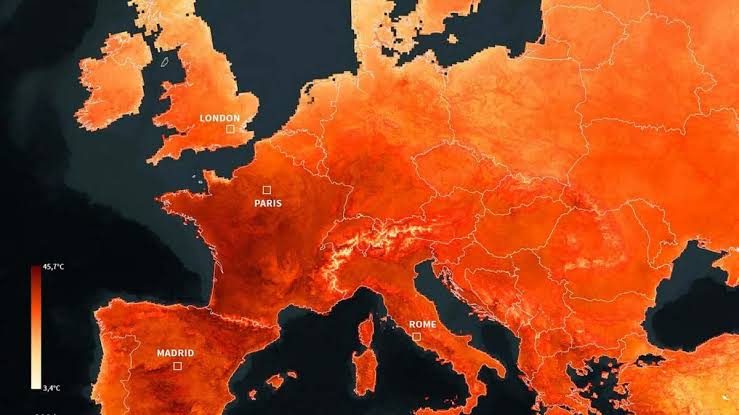

Over a thousand persons have died across Europe since last week as an unprecedented heatwave continues to grip the continent.
The World Health Organisation Director-General, Tedros Ghebreyesus says the 1,300 deaths were linked to extreme temperatures recorded across Europe since June 21. He described the heat stress as a “silent killer” and warned that such weather events are becoming more frequent and intense due to global warming.
According to Tedros, Europe is warming at nearly twice the global average rate, while much of its infrastructure, including homes, workplaces and schools, was not designed to withstand prolonged periods of extreme heat. Therefore, he urged governments to strengthen heat-health action plans to better protect vulnerable populations, particularly the elderly and those with underlying health conditions.
The heatwave, which initially swept through Western Europe, has expanded eastward, with Germany, Poland, the Czech Republic and several other countries recording some of the highest temperatures in their history. Germany registered 41.7 degrees Celsius in Coschen on Sunday, marking the country’s hottest day for the third consecutive day, while authorities warned temperatures could climb to 42 degrees Celsius in some regions.
Neighbouring Poland set a new national temperature record of 40.5 degrees Celsius in the western town of Słubice, while the Czech Republic recorded 41.1 degrees Celsius in Doksany. Denmark also experienced its hottest day since records began in 1874, with temperatures reaching 36.6 degrees Celsius, and Slovakia endured its warmest night on record as temperatures failed to drop below 26.3 degrees Celsius.
France has been among the hardest-hit nations. Health authorities reported about 1,000 excess deaths since Wednesday, with most victims aged 65 and above. Officials also recorded a rise in deaths occurring at home, while local media reported dozens of fatalities linked directly to the extreme weather. Wildfires have also intensified across parts of the country compared with the same period last year.
The soaring temperatures have severely disrupted daily life across Europe. Germany’s national rail operator, Deutsche Bahn, allowed passengers to cancel long-distance journeys without penalty over concerns that excessive heat could damage railway infrastructure. A section of the A7 motorway near Hamburg was also temporarily closed after the road surface cracked under the intense heat.
Researchers warn that Europe is warming faster than any other continent, resulting in longer and more severe heatwaves that are placing growing pressure on public health systems, infrastructure, agriculture and the environment. They also cautioned that many European buildings were designed to retain heat during cold winters, leaving millions of residents increasingly vulnerable as extreme summer temperatures become the new normal.