

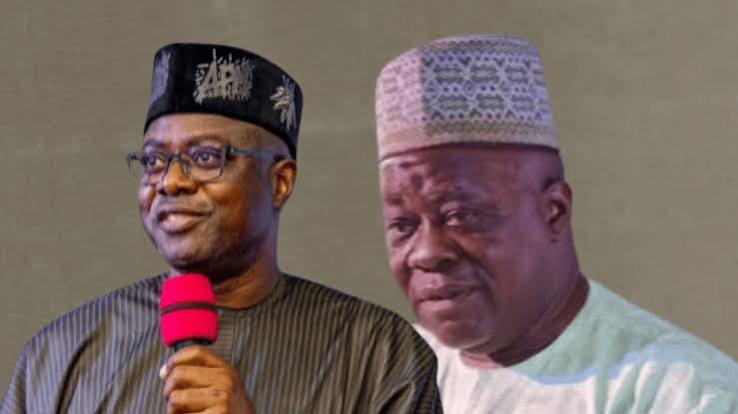

Professor of political science and Senior Fellow at the Centre for Democracy and Development, Jibrin Ibrahim, has described the Judicial Commission of Inquiry set up by the Oyo State Government to investigate the abduction of students and teachers in Oriire Local Government Area as an imperative initiative.
Professor Ibrahim, who is a member of the commission, said the inquiry had provided an opportunity to investigate the immediate and remote causes of the incident and examine what could be done by governments, security agencies and communities to address the growing threat of abductions across the country.
Speaking in a one-on-one interview with the Oyo State Commissioner for Information, Dotun Oyelade, Ibrahim said the commission’s findings showed that insecurity had become a national crisis, noting that attacks on educational institutions had spread from the North-East to the North-West, North-Central and now the South-West.
“I think it was an excellent idea for governor Seyi Makinde to establish this Judicial Commission of Inquiry,” Ibrahim said, recalling the series of attacks on educational institutions since the Chibok abduction of 2014.
According to him, the Oriire incident demonstrated that the challenge of terrorism and banditry was no longer confined to any particular part of the country.
He said the commission had uncovered important lessons about the trajectory of insecurity in Nigeria, including the ability of terrorists and bandits to operate in forests and difficult terrains and still thrive for so long.
“Terrorism has become extremely capable and has a lot of capacity and capability in terms of carrying out its nefarious activities, and what we learned in what happened in Oyo State is that they’ve been able to achieve mastery of the forests, even in faraway Old Oyo National Park.”
Professor Ibrahim said the development should serve as a source of concern for the entire country, stressing that the challenge required a coordinated response involving federal, state and local governments as well as communities.
He explained that the commission did not limit its approach to examining what security agencies could do, but also considered the roles of state, local governments, communities, hunters and vigilante groups with knowledge of local terrain.
The professor commended the composition of the commission, describing it as balanced and made up of members with strong professional expertise on the issue on hand.
Professor Ibrahim disclosed that the commission interviewed as many as 72 witnesses during its investigation, describing the process as fascinating and insightful.
He also noted that some federal agencies, including the Department of State Services and the Office of the National Security Adviser, did not participate in the proceedings despite invitations.