

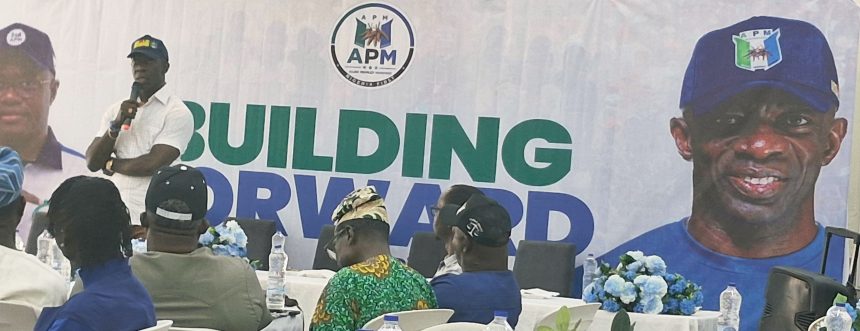

The Oyo State governorship candidate of the Allied People’s Movement (APM), Bimbo Adekambi, has declared his support for full local government autonomy, while promising to pursue a data-driven approach to governance if elected governor in 2027.
Adekambi, a policy expert and chartered accountant, made the remarks while interacting with broadcasters and media managers in Oyo State as part of engagements ahead of the 2027 general elections.
Responding to questions on local government administration, the APM candidate said he was “100 per cent” in support of local government autonomy, arguing that the principle was already recognised by Nigerian law but was not being fully implemented in practice.
According to him, true autonomy should extend beyond financial allocations to include recruitment, elections, training, budgeting and implementation at the local government level.
He said his administration would strengthen financial systems and introduce greater uniformity and accountability in local government operations if elected.
Adekambi also defended the need for continuity in governance, particularly in relation to major infrastructure projects such as the Oyo State Circular Road.
He said the road remained strategically important because of its potential to connect different parts of the state and open up new economic corridors.
“Circular road was conceptualised for a reason. It opens up the corridors to bring them together,” he said, stressing that he would continue projects that had demonstrable value to the people rather than abandoning them because they were initiated by a previous administration.
On the challenges of street trading, begging and the growing number of out-of-school children, Adekambi said the issues should be addressed by tackling their underlying social and economic causes.
He disclosed that, during his previous involvement in government programmes, efforts were made to develop a poverty map for the state to determine the location and scale of vulnerable populations, including out-of-school children.
He argued that reliable data was critical to designing effective interventions and ensuring continuity when administrations change.
According to him, addressing poverty among parents, particularly by improving access to credit and economic opportunities, could reduce the pressure on children to engage in street hawking.
He also acknowledged existing efforts by the current Oyo State Government to return out-of-school children to classrooms, saying such initiatives should be sustained and strengthened.
Adekambi further highlighted the role of the Community and Social Development Agency in providing infrastructure to underserved communities through a bottom-up approach.
He said his administration would focus on the root causes of social problems rather than merely treating their symptoms.
On the media, the APM candidate described journalists and broadcasters as critical stakeholders in governance and said his administration would create room for greater engagement with media professionals.
He said his proposed governance framework included a focus on digital economy and innovation, which could provide opportunities for collaboration with media organisations and other technology-driven sectors.
Adekambi, however, challenged media professionals to also improve the quality of proposals and strategies they present to government, arguing that the relationship between government and the media should involve both demand and supply.
He said government should be open to credible communication strategies while media organisations should develop innovative ways of demonstrating their value to the administration and the wider public.
The governorship candidate also argued that Oyo State must look beyond basic governance responsibilities such as payment of salaries and pensions and develop a clear long-term economic vision.
He identified education, agriculture, health and security as fundamental pillars that any government must address, but said these should serve as the baseline rather than the ultimate measure of development.
Adekambi said capacity building, digital innovation and the development of the state’s intellectual capital should form part of Oyo’s strategy for future growth.
He argued that digital innovation cuts across virtually every sector, including education, healthcare, agriculture, governance and security.
According to him, Oyo State possesses significant comparative advantages in intellectual and entrepreneurial capital, pointing to the growth of technology businesses and innovation hubs emerging from the state.
He cited the success of indigenous technology entrepreneurs as evidence of the potential within Oyo State, arguing that government should create an environment capable of retaining and supporting such talents.
The APM candidate said the rapid evolution of artificial intelligence, the Internet of Things and other technologies meant that governments could no longer rely exclusively on traditional development models.
He called for a governance approach that would evolve with changing technology and economic realities.
Adekambi said his broader vision was to move Oyo State beyond what he described as “pedestrian” measurements of government performance and toward a system that prioritises innovation, human capital development, economic productivity and sustainable growth.