


President Bola Tinubu has reaffirmed his decision to remove Nigeria’s petrol subsidy, declaring that he has no regrets about the policy and ruling out any return to the previous arrangement.
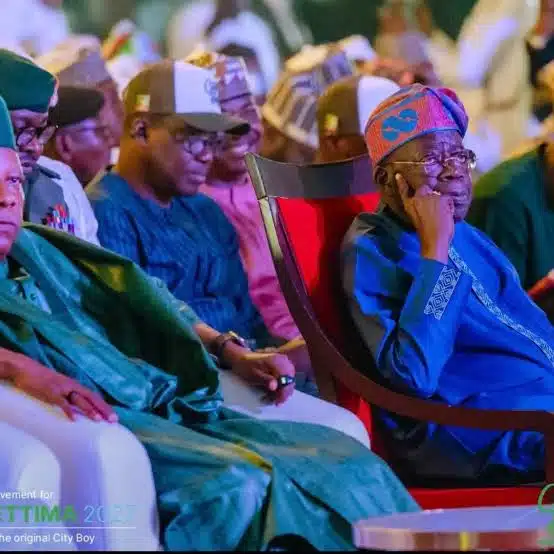
The President made the remarks on Monday evening at an event tagged Together till 2027: An Evening with Original City Boy, organised by the City Boy Movement alongside the Relax-Tinubu-Is-Fixing-Nigeria movement, groups supporting his re-election bid.
Tinubu defended the decision to end the subsidy, which he announced on his inauguration day in May 2023, arguing that the country could no longer sustain the cost of maintaining it.
“I came, and I removed the subsidy the first day,” the President said, adding that the government had been facing severe financial constraints and had little capacity to continue financing the scheme.
He also criticised proposals by his political opponents to restore the subsidy, taking an apparent swipe at former Vice-President Atiku Abubakar, the African Democratic Congress presidential candidate, who has advocated a return to subsidy payments.
Using a biblical analogy, Tinubu compared the removal of the subsidy to the Israelites’ departure from Egypt under Moses, arguing that the country should not reverse a decision he considers necessary for economic progress.
Drawing from his knowledge of both the Bible and the Holy Quran, the President recalled the biblical account of the Red Sea parting as Moses led the Israelites away from Egypt.
“You cannot ask Moses to go back to Egypt,” he said, insisting that Nigeria must continue along its current economic path rather than return to the previous subsidy regime.
Tinubu maintained that his administration remained committed to developing new ideas and pursuing policies aimed at moving the country forward.
“With your energy, your support, Nigeria will never go back to Egypt. No regrets,” he declared.
The President also expressed optimism about Nigeria’s economic outlook, citing reports of economic growth in China as he argued that the country was moving in the right direction.
He said the economy was growing steadily and expressed confidence that ongoing reforms would create better prospects for Nigerians.
The subsidy removal has remained one of the most consequential economic decisions of Tinubu’s administration, with the policy significantly altering the cost of petrol and intensifying debates over living expenses, government spending and the impact of economic reforms on households.
While the President has maintained that reversing the policy is not an option, the issue is expected to remain a major point of debate as political parties prepare for the 2027 general elections.