

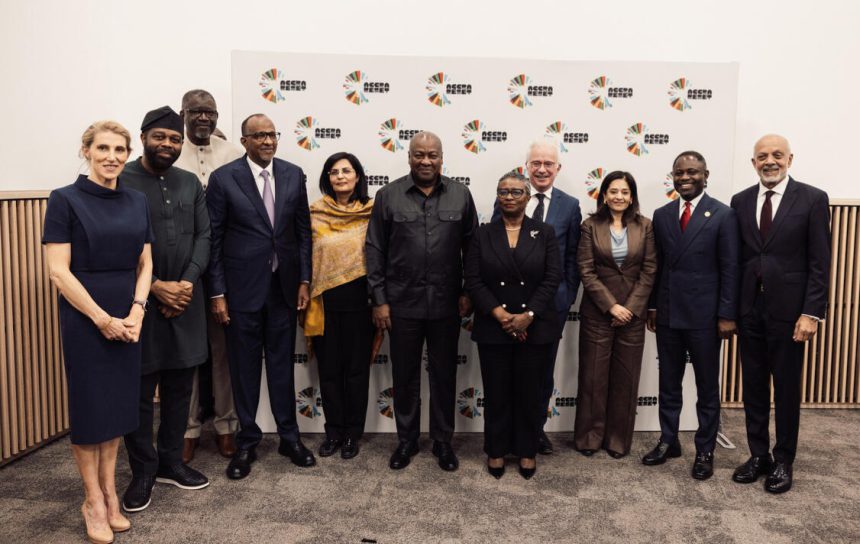

Global political leaders, health ministers, development institutions and experts are demanding restructuring of global health systems to strengthen country ownership, sustainable financing and local capacity development, during the Accra Reset High-Level Dialogue held on the sidelines of the 79th World Health Assembly in Geneva.
The event, themed “Geneva Clarion Call: Rethinking Power, Financing and Global Health Delivery,” drew more than 250 high-level participants, including heads of state, health ministers, multilateral organisations and philanthropic institutions, who examined new approaches to global health reform.
The dialogue forms part of the broader Accra Reset initiative launched by John Dramani Mahama during the 2025 United Nations General Assembly. The initiative seeks to create a development and health framework centred on national sovereignty, coordinated implementation, domestic capacity building and regional cooperation.
Delivering his presidential address, Mahama outlined the next phase of the initiative and unveiled two additional components under the Accra Reset Sovereign Health Agenda, the Reform Observatory (RIO) and the Health Investment National Gateways Enabler (HINGE), both designed to support reforms and strengthen investments in locally driven healthcare systems.
“If the Accra Reset can move health commitments into working programmes, it can do so for any sector. Health is the vanguard, the proof of concept and the moral imperative,” Mahama said.
Discussions at the forum focused on the future of global health governance, financing transitions and strengthening national healthcare systems, with speakers stressing the importance of allowing countries to drive their own healthcare priorities rather than relying on fragmented external interventions.
Among participants at the ministerial dialogue was Budi Gunadi Sadikin, who argued that sustainable healthcare requires stronger financing mechanisms capable of attracting long-term investment.
“The money is there. My proposal is to help countries build effective healthcare financing pathways so health ministers can make stronger investment cases to financial institutions,” he said.
Similarly, Alexandre Padilha called for greater participation of developing nations in shaping global policy decisions.
He said countries in the Global South must play a central role in global decision-making and that health sovereignty should move beyond rhetoric into practical implementation through stronger systems and sustainable financing.
Aden Duale also highlighted domestic funding efforts in his country, stressing the need for nations to take ownership of healthcare financing and delivery.
Nigeria also featured in the dialogue through Kelechi Ohiri, who spoke on efforts to strengthen healthcare coordination and improve integration of health programmes.
According to him, Nigeria’s health sector blueprint has provided a platform for aligning national priorities and improving collaboration with development partners.
Global health institutions represented at the event, including Gavi, The Global Fund and the Pandemic Fund, also highlighted ongoing reforms aimed at supporting long-term country ownership and sustainability.
Participants broadly agreed that although there is growing consensus on the need for reform, implementation remains the next major challenge.
The gathering concluded with calls for stronger partnerships, improved coordination and practical actions capable of translating policy discussions into measurable improvements in healthcare systems and outcomes across Africa and other developing regions.